

An Astrotourism Voyage: Sailing to Earth's Darkest Skies Above the Coral Triangle
The generator goes off around ten, and with it the last light on the boat. A guest who had spent the day diving climbs to the top deck expecting the sky she has always known, and stops on the top step. What she is looking at does not resemble the sky over any city or any resort she has visited. The Milky Way is not a faint smudge; it is a structured band with a bright bulge low in the south, dust lanes cutting through it, casting enough light to throw a faint shadow on the teak. She has to be told which of the countless points is a planet, because there are simply too many stars for the shapes she memorised as a child to survive. This is what an astrotourism voyage across the Coral Triangle offers that almost nowhere on land can match: dark sky sailing far enough from human light that the universe returns to its full, uncensored self.
Eastern Indonesia holds some of the darkest skies remaining on Earth, and a private boat is the only way to sit under them in comfort. Anchored between uninhabited islands, hundreds of kilometres from any glow, you get a night sky that most people alive have never actually seen.
The Bortle Scale explains why this sky is unlike your sky at home
Astronomers measure night-sky darkness on the Bortle Scale, a nine-point ranking where Class 1 is the darkest sky achievable on the planet and Class 9 is the washed-out orange of an inner city. Most people in the United States and Europe live their entire lives under Class 5 to Class 8 skies and have never stood beneath anything better. Even celebrated dark-sky parks on land usually sit around Class 2, ringed by the distant domes of far-off towns.
Anchored in the remote eastern reaches of Indonesia, far from any settlement large enough to register, the sky above Silolona routinely approaches Class 1 to 2, the darkest end of the entire scale. The practical effect is hard to overstate until you have seen it. At Class 1, the Milky Way is bright enough to cast shadows, the zodiacal light stands up like a pale pillar after dusk, and faint objects you have only ever seen in photographs resolve to the naked eye. There is no light pollution to subtract, because for a hundred kilometres in every direction there is almost no light at all.
What is overhead changes with the month, and the south is the prize
Because these voyages run at tropical and southern latitudes, the sky on offer includes sights that most Northern Hemisphere travelers can never see from home, and the calendar decides which.
The richest window for the galaxy itself falls in the dry Komodo season, roughly June through September, when the bright core of the Milky Way in Scorpius and Sagittarius rides high overhead through the evening, the single most spectacular stretch of our galaxy laid directly above the mast. Scorpius, with red Antares at its heart, hangs near the zenith rather than scraping the horizon as it does from northern cities. Sail the eastern grounds of Raja Ampat and Banda between October and April and the deep southern sky comes into its own: the two Magellanic Clouds, our satellite galaxies that are invisible from the entire Northern Hemisphere, sit clear of the horizon as soft luminous patches, and Canopus and the jewelled field around the Southern Cross swing into view. On a night near new moon, with no lunar glare to wash the fainter light away, all of it arrives at once.
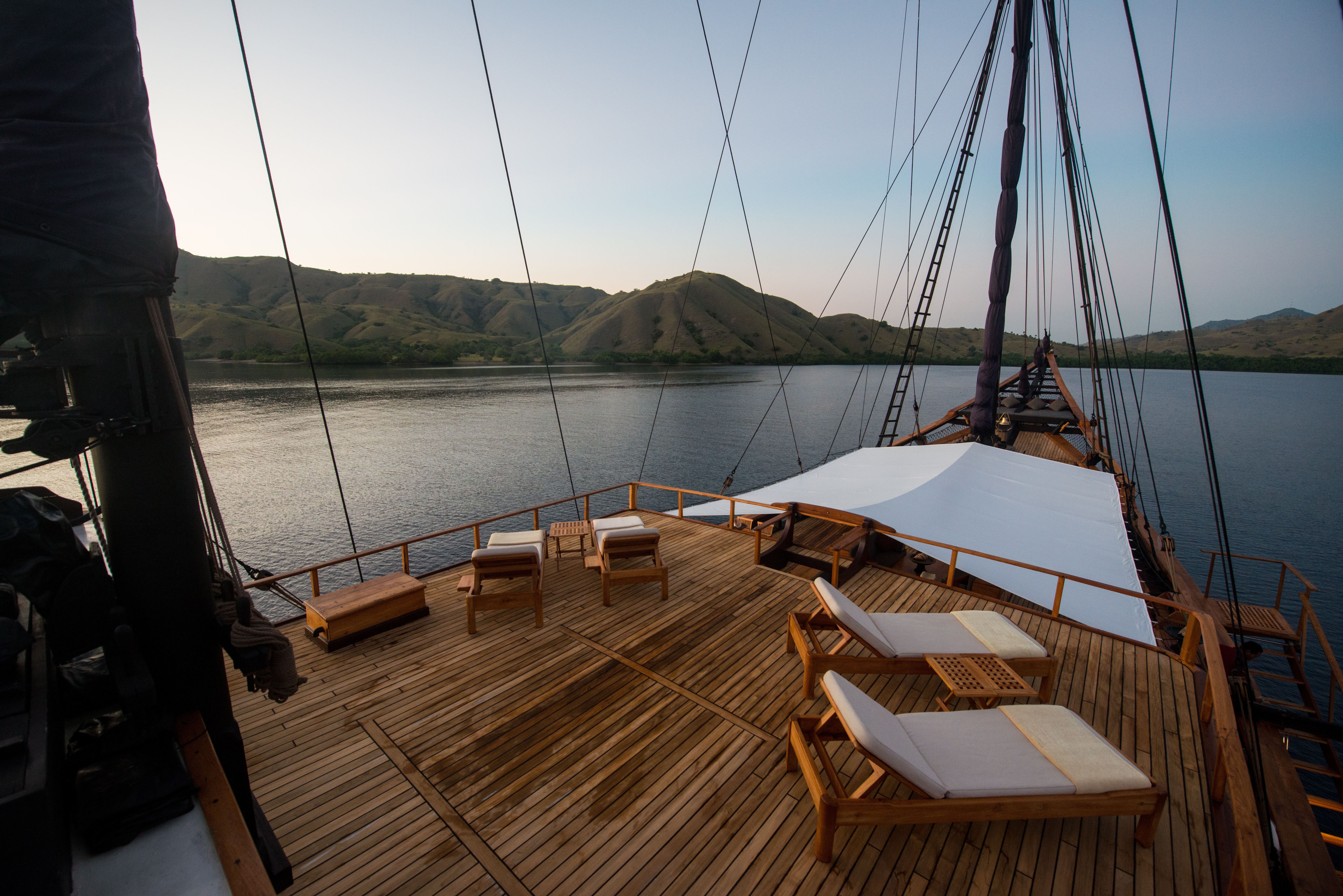
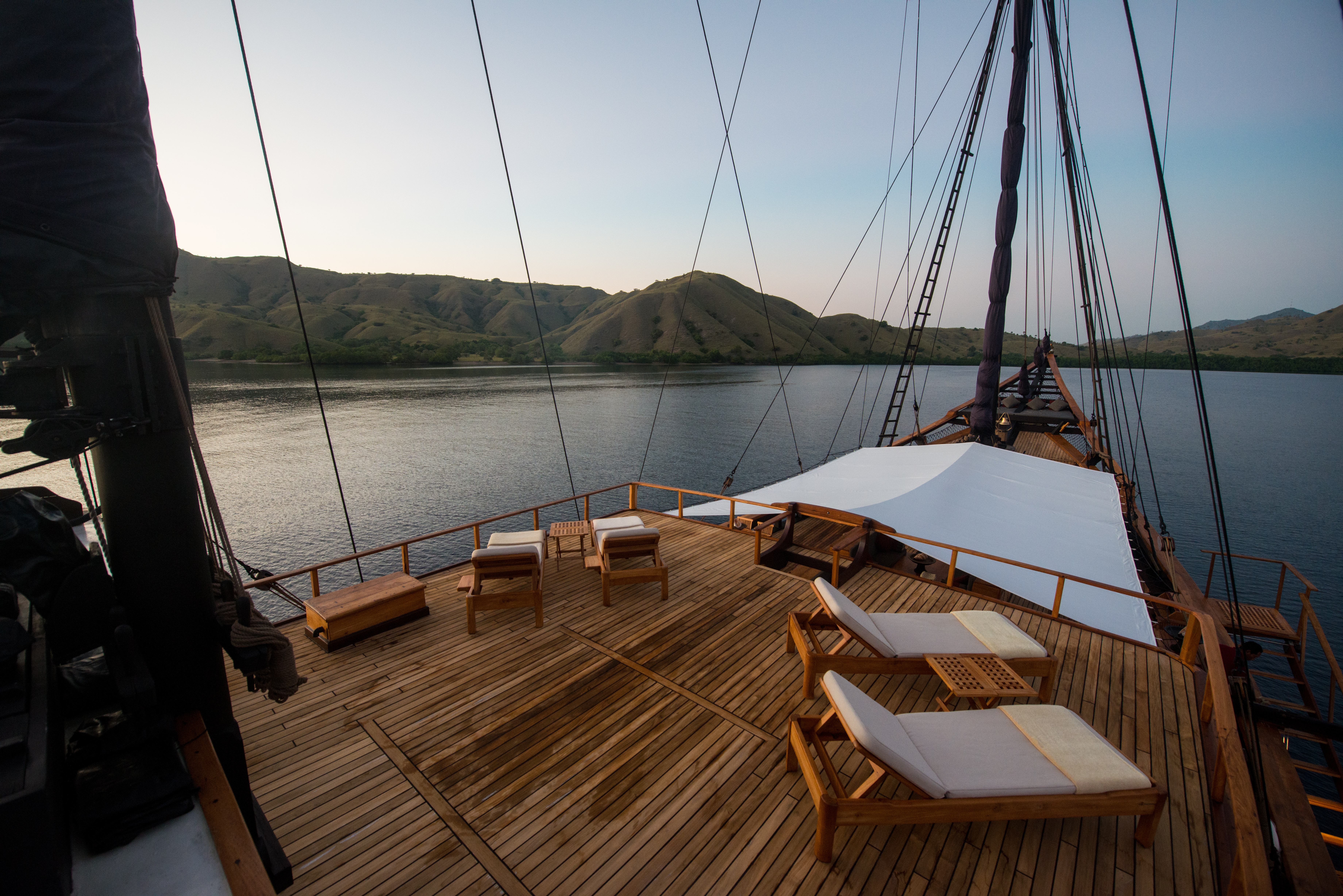
The people who built this boat once navigated by these exact stars
There is a reason the constellations overhead feel at home above a phinisi. The vessel comes from South Sulawesi, and the Bugis sailors of that coast were among the most accomplished celestial navigators in the maritime world, crossing these same waters for centuries guided by the stars now framed by your rigging. They read the sky as a working instrument. The Southern Cross, which they called bintoéng bola képpang, the incomplete house star, marked south; the belt of Orion, bintoéng tallu, the three stars, gave them east; the rising of particular star patterns told them when the monsoon was about to turn.
Knowing this changes what you are looking at. The same Southern Cross that a Bugis captain used to find his way home four hundred years ago is the one clearing your horizon tonight, above a boat his descendants in Ara built by hand. The crew carry fragments of this knowledge, and an evening on deck can drift easily from a planet in the eyepiece to the older, human story of how these islands were first sailed by reading exactly what you are now watching for pleasure.
Silolona plans the anchorage around the sky, not the other way round
None of this is left to luck, and that is where a private boat separates itself from any land-based alternative. A serious stargazing night depends on three things aligning: a dark anchorage far from settlement, a clear horizon, and a sky uncontaminated by moonlight. Silolona can arrange all three deliberately.
Because the itinerary is private and flexible, the route can be shaped so that the darkest, most open anchorages coincide with the nights around new moon, when the sky is at its blackest. Captain Kamto, who reads these waters closely, can position the boat where the southern horizon is unobstructed for the Magellanic Clouds, or tuck into a bay whose high walls block even the faintest far-off glow. The crew watch the weather for the clear, dry nights that follow a passing system. A land resort is fixed wherever it was built, under whatever sky and whatever lights it happens to have. A boat can simply sail to the darkness and wait for the moon to leave. That mobility, paired with genuine comfort, is what makes this the rare setting where the most intellectually extraordinary night of a journey is planned for rather than stumbled upon.
With Silolona Sojourns, the night sky becomes a destination in its own right, planned with the same care as any reef or ridge. Whether you sail Komodo from May to September for the galactic core overhead, or the eastern waters of Raja Ampat and the historic Banda islands from October to April for the deep southern sky, the darkness is real and the timing can be built around the moon. To sail aboard Silolona and Si Datu Bua, or to plan a private journey timed to the darkest skies of the year, you are warmly invited to enquire.
References
Bortle JE. Introducing the Bortle Dark-Sky Scale. Sky Telesc. 2001;101(2):126-129. Available from: https://skyandtelescope.org/astronomy-resources/light-pollution-and-astronomy-the-bortle-dark-sky-scale/
Ammarell G. Bugis Navigation. New Haven (CT): Yale University Southeast Asia Studies; 1999. doi:10.2307/j.ctv16f6cff
UNESCO. Pinisi, art of boatbuilding in South Sulawesi. Representative List of the Intangible Cultural Heritage of Humanity; 2017. Available from: https://ich.unesco.org/en/RL/pinisi-art-of-boatbuilding-in-south-sulawesi-01197