

Indonesian Culinary Geography: How Silolona's Kitchen Changes with Every Destination
At six in the morning off Banda Neira, a wooden skiff pulls alongside the hull before most guests have stirred. A fisherman hands up a yellowfin tuna still cold from the deep, and Ketut Kusumawardana, the chef who comes from Buleleng on the north coast of Bali, decides the lunch menu on the spot. By the time you surface from your first dive, part of that fish is sashimi, cut within the hour it left the water. This is how an Indonesian cuisine yacht actually works when the kitchen is bound to a place rather than a printed card: the menu is written by the morning, by the tide, and by whoever rowed out to meet the boat. Silolona carries no fixed carte. It carries a geography you can taste, and the food changes as deliberately as the coordinates do, which is what people are really asking about when they search for the best regional food onboard a private yacht in these waters. Indonesia holds something close to three hundred distinct regional cooking traditions, shaped by island, faith, trade route, and what grows in volcanic soil versus what is pulled from a reef. Most vessels flatten all of that into a single "Asian fusion" offering that tastes the same in Komodo as it does in Papua. Silolona does the opposite. When the vessel moves, the kitchen moves with it.
The Kitchen Reads the Chart Before the Guests Do
Sail into the Banda Islands, the old Spice Islands, and the food turns toward nutmeg and mace, the spices that once drew European fleets across the world for these few square miles of volcanic rock. Bandanese cooking uses nutmeg not as a dessert dusting but as the backbone of savory curries, and a fish head simmered in coconut and Banda spice tastes like the history of the place rather than a garnish laid over it. In Flores, the register shifts again toward smoked meats cured over open fire in the highland villages, the kind of preparation that predates refrigeration and survives because it tastes better than the alternative. Move east into Papuan waters, and sago replaces rice as the staple, smoked reef fish arrives with the dense, slightly sour flatbread that Papuan communities have eaten for centuries, and the whole table reorients around ingredients most guests have never encountered. None of this is theater. It is a straightforward consequence of cooking where you are, with what the place produces, on the day you arrive.

Sourcing Happens at Dawn, in Markets, from Small Boats
Ketut's sourcing philosophy is built on a refusal to provision the whole trip from a single warehouse in Bali. He shops the journey as it unfolds. In a working harbor town the day often begins before sunrise at the wet market, where he walks past the stalls reading what came in overnight: which fisherman had the better catch, whose chilies are fresher, which vendor has the ripe jackfruit or the young coconuts worth carrying back to the galley. Prices are settled quietly, in the local rhythm, and the day's cooking follows the market rather than dictating to it.
Between market towns, the boats come to Silolona. Fishermen who know the vessel's route intercept it with tuna, grouper, reef fish, and lobster, handing the catch up over the rail in exchange for cash and a good word. There is no cold chain to argue with when the fish arrives alive. The sashimi cut within the hour reflects a simple fact of supply: the source is a man in a skiff, not a warehouse three flights away. This is the part of the experience that the numbers on a rate sheet cannot convey, and it is the part discerning travelers remember longest.
A Menu That Behaves Like a Map
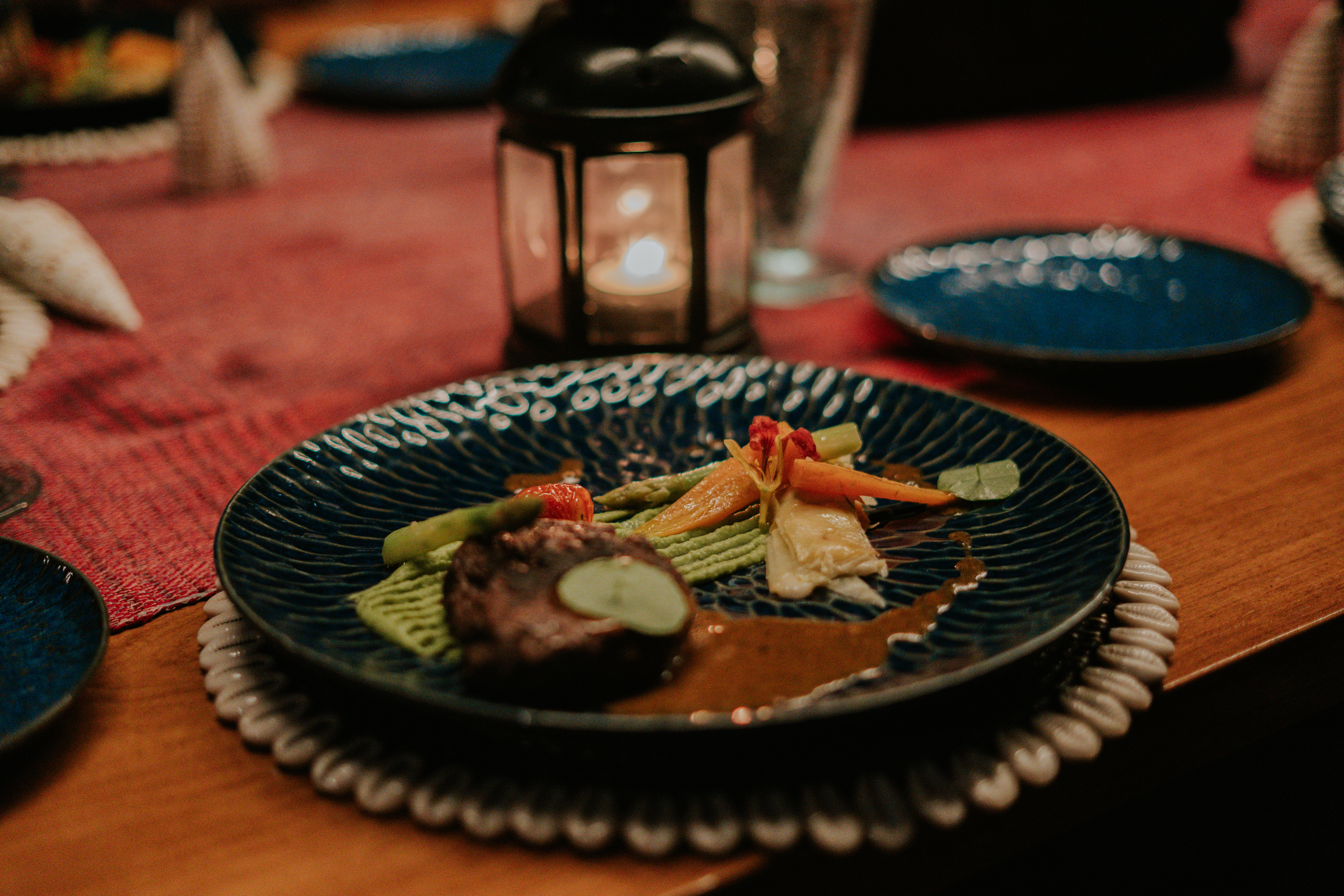
Read the week's meals in order and you can reconstruct the route without a chart. Manadonese heat as the vessel works the waters off North Sulawesi, where the cooking runs fierce with chili and lime. Bandanese nutmeg curries through the Spice Islands. Florinese smoked meat in the volcanic middle. Sago and smoked fish as the seas turn Papuan. Between the regional anchors, Ketut and the galley team fold in the fusion and Western dishes that a mixed international table expects, and the bread and pastries are baked on board each morning, so the croissant at breakfast and the sashimi at lunch belong to the same kitchen and the same day.
The crew makes this possible, and continuity is the reason it holds together. Many of Silolona's seventeen hands have sailed these routes for years, long enough to know which harbor delivers the best chilies and which anchorage the fishermen favor. Ketut, a Balinese chef with a particular hand for dessert and pastry, leads a galley that produces destination-specific menus without losing the coherence that lets a family return year after year and still recognize the table. That kind of knowledge is not something a new vessel can install. It accrues.
What the Table Tells You About the Journey
There is a reason food carries so much weight on a voyage like this. When you eat Bandanese curry at anchor off the island where the nutmeg grew, or sago the day you first see the Papuan coast, the meal stops being fuel and becomes the most direct way you have of understanding where you are. The kitchen is doing the same work as the expedition leader and the dive guide: translating a place into something you can take in directly. It simply does it through flavor, which is the sense that stays with people longest after they have gone home.
Anthropological research on maritime Southeast Asia has long argued that food is one of the clearest records of trade, migration, and cultural exchange across the archipelago, which is precisely what a route-following menu puts back on the plate.1 Studies of the Coral Triangle underline why the sourcing matters too: these are among the most biodiverse marine waters on earth, and eating from them thoughtfully, in season and in small quantities, is part of traveling through them with any integrity.2 The spice trade that shaped Banda, meanwhile, is not backdrop but the actual origin of flavors still simmering in the galley today.3
With Silolona Sojourns, the kitchen is not an amenity bolted onto the voyage; it is one of the truest expressions of it, changing with every destination the way the water and the light and the culture on shore do. Sail the nutmeg islands of Banda, the reefs of Raja Ampat, or the dragon coasts of Komodo, aboard Silolona and Si Datu Bua, and let the menu follow the map. When you are ready to taste the journey rather than read about it, enquire and let the galley meet you at dawn.
References
- Janowski M. Food in traumatic times: memory, place and exchange in island Southeast Asia. Food and Foodways. 2012;20(3-4):175-198. Available from: https://doi.org/10.1080/07409710.2012.715968
- Veron JEN, Devantier LM, Turak E, Green AL, Kininmonth S, Stafford-Smith M, et al. Delineating the Coral Triangle. Galaxea, Journal of Coral Reef Studies. 2009;11(2):91-100. Available from: https://doi.org/10.3755/galaxea.11.91
- Ellen R. On the edge of the Banda zone: past and present in the social organization of a Moluccan trading network. Journal of Southeast Asian Studies. 2004;35(1):163-165. Available from: https://doi.org/10.1017/S0022463404270095