

Sunset Ritual: Why the Hour Before Dinner on a Phinisi Becomes the Most Anticipated Moment
The engines cut somewhere around five. You feel it before you hear anything: the long vibration in the teak underfoot goes still, and the boat settles into the water like it has finally stopped holding its breath. Then the anchor chain runs out, a sound like a slow drumroll from the bow, and the sea takes over the work of moving you. From the aft deck, a steward you spoke to at breakfast is already setting glasses on a low table, unhurried, as if he decided an hour ago that this was the spot. He did. The sundowner ritual aboard Silolona begins before you know you want it, and by the time you climb up from your cabin, the light has started doing the thing that no photograph on your phone will explain to the friends you send it to.
This is the hour a phinisi sunset in Indonesia earns its reputation, and it has almost nothing to do with the drink in your hand. It has to do with timing, silence, and a crew that has watched this light thousands of times and still stops to look.
The engines stop, and the day changes register
There is a specific quiet that arrives when a working boat powers down at anchor. On Silolona, a 50-metre vessel built in 2004 by the Master Konjo builders of Sulawesi, the day up to this point has a low mechanical pulse under everything: the generator, the movement, the wind against the rig. When Captain Bambang or Captain Kamto brings her to rest in a cove off Rinca or in the lee of a Raja Ampat limestone island, that pulse disappears in a single breath. What replaces it is not silence exactly. It is the reef exhaling. Small waves working a beach a hundred metres off. A hornbill somewhere in the trees, the beat of its wings audible before you spot it. Ice against glass. Your own voice, which you notice you have lowered without deciding to.
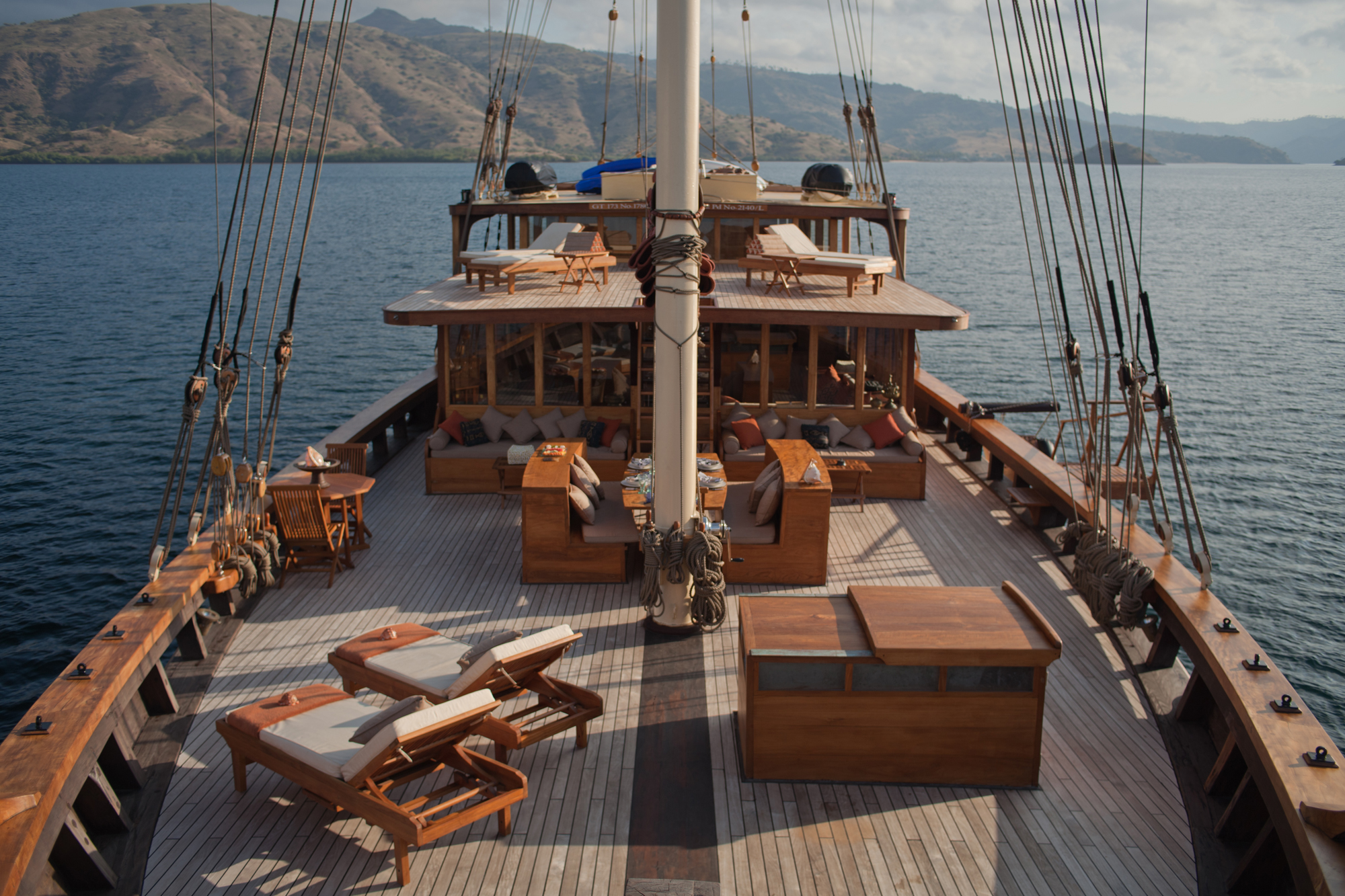
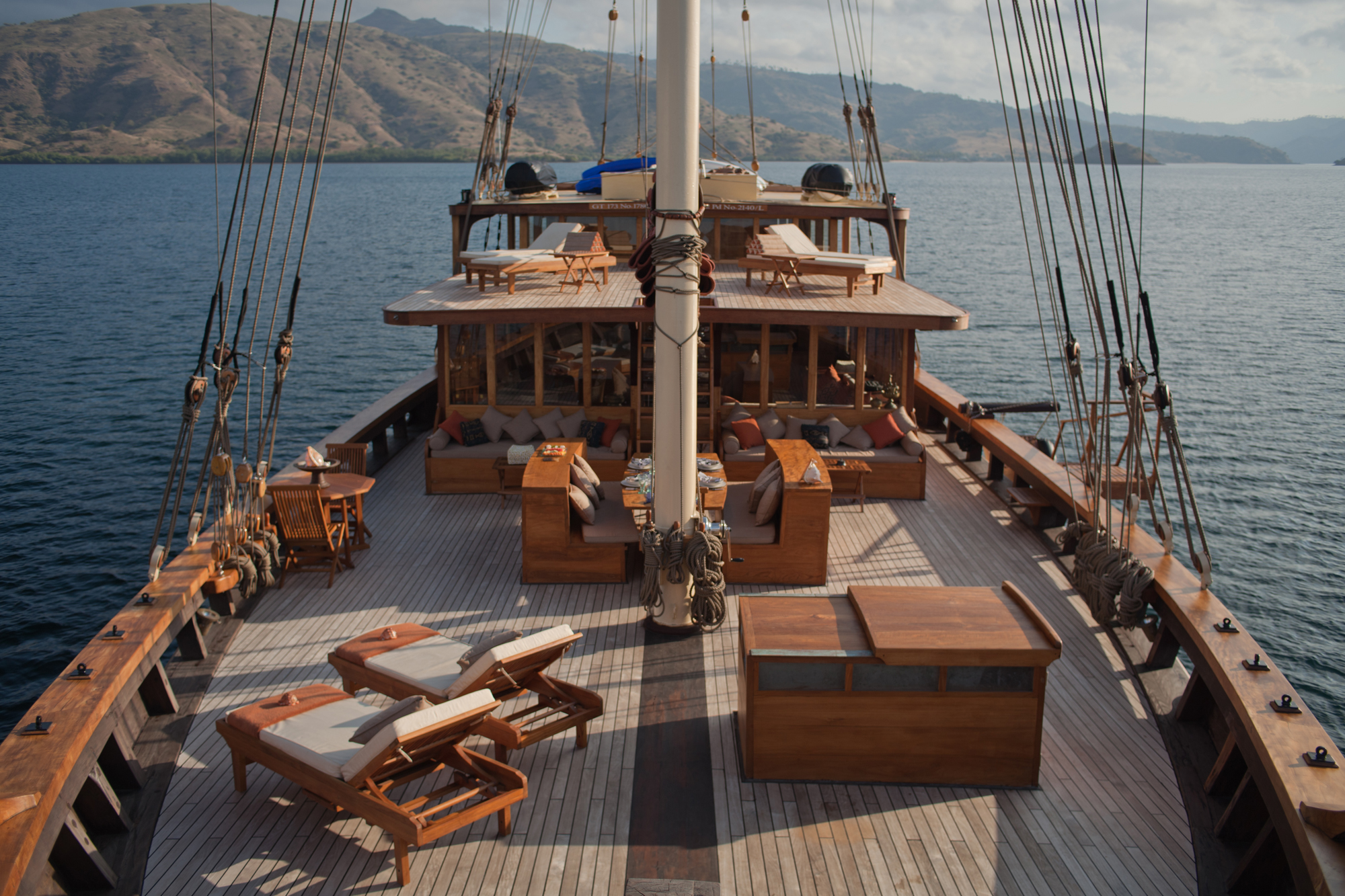
The crew choreographs the anchorage for this. The boat is turned so the open deck faces west, so nothing on board stands between you and the horizon. Cushions appear on the day beds. Someone has already been ashore to check the sand. None of it is announced.
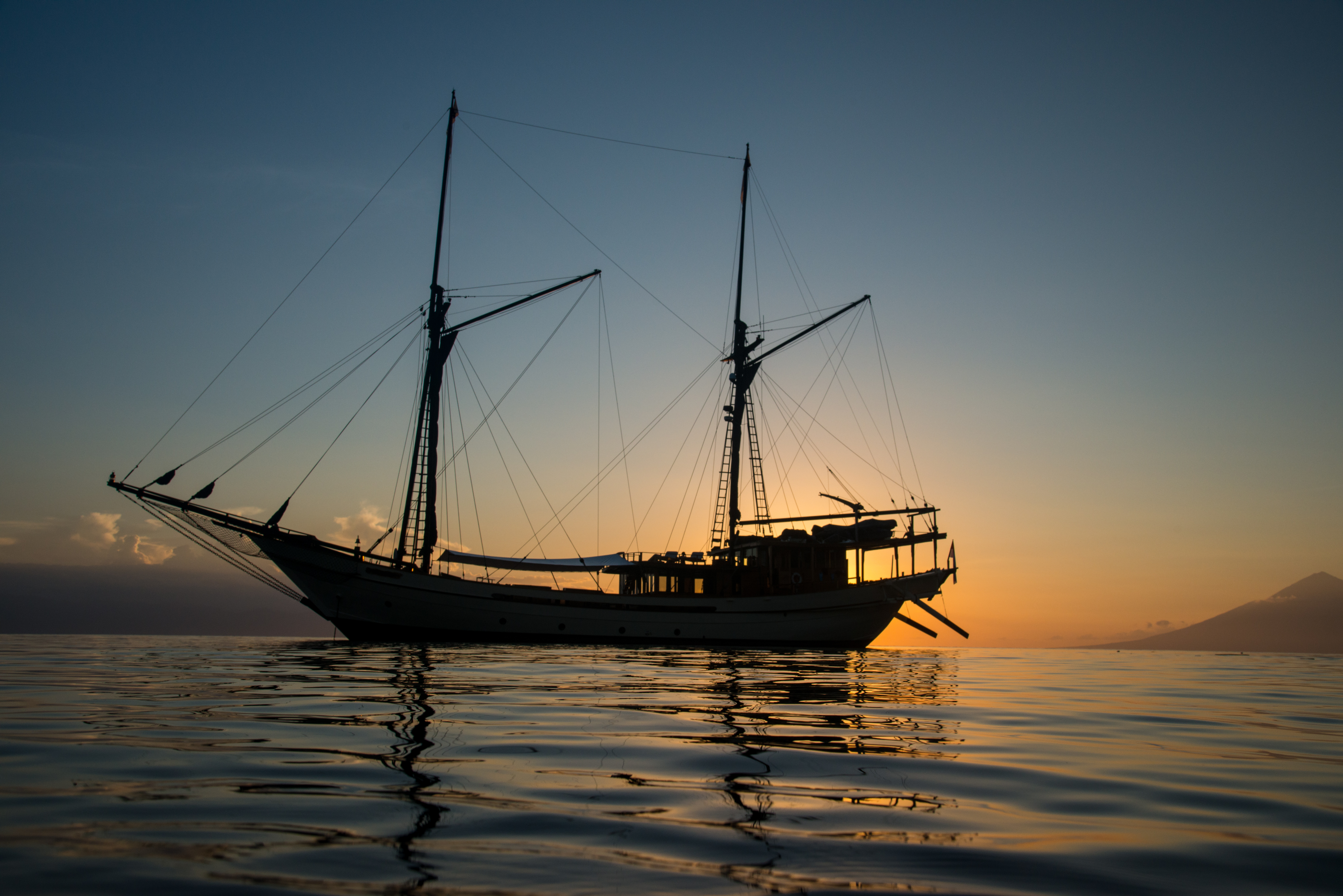
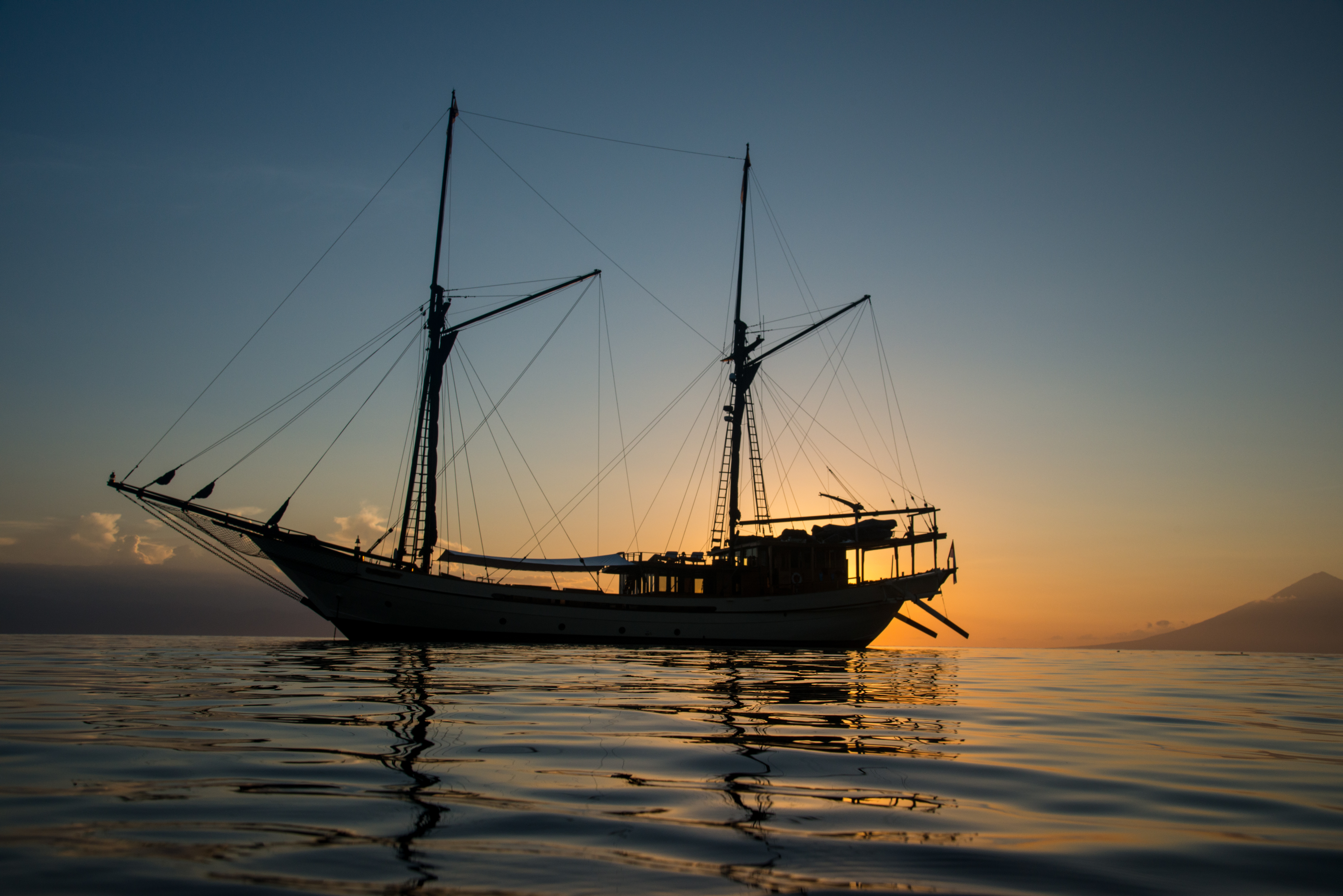
Light at five degrees south behaves differently, and your eye knows it
People who live in temperate countries carry an unconscious expectation about sunsets: a long, slow European evening that softens for two hours before the sun finally gives up near ten at night. Near the equator, where most Silolona journeys unfold between roughly five degrees north and ten degrees south, the sun takes a steeper, faster path to the sea. Twilight is short. The whole performance, from the first warm slant across the deck to the last green line on the water, can run under forty minutes.
That compression is exactly what makes it feel rare. There is a well-documented reason the colours run so deep here. As the sun drops low, its light travels through far more atmosphere before reaching you, and the shorter blue wavelengths scatter away, leaving the long reds and oranges to dominate the sky.Over the Coral Triangle, with humid marine air and no city haze for hundreds of kilometres, that scattering happens across a clean, enormous canvas. The reds are not the bruised industrial reds of a polluted skyline. They are clarified. The clouds over Komodo's dry hills catch the last light and hold it like coals, and the water goes from turquoise to hammered copper to something with no name, and then, quite suddenly, it is over. You understand why the crew stopped what they were doing to watch. You did too.
The station is ready before you are
Watch the anticipatory behaviour, and you learn something about how this boat actually works. Ketut, the chef from Buleleng in north Bali, times the canapés so they reach the deck while the light is still gold, not after it has gone. The breads and pastries that come with them were baked on board that morning. Yande, the chief purser, has already noticed which guest drifted toward the bow last night to be alone and which couple wanted company, and he arranges the deck accordingly without a word passing about it. If you dive with Goris, the instructor from Flores who was part of the original team that built this boat, he will have surfaced in time to be up top with a camera, because he knows the ten minutes after a dive at golden hour are the ten minutes you will want back later.
None of this reads as service in the hovering, anxious sense. It reads as people who know the rhythm of their own vessel so well that they are simply ahead of you, quietly, the way a good host is already refilling the water before you reach for it. Seventeen crew serve up to ten guests, a ratio that reads well on paper and matters far more in practice: it lets the sundowner hour feel effortless while a great deal of invisible effort holds it up.
Why this hour, and not dinner, becomes the one you talk about
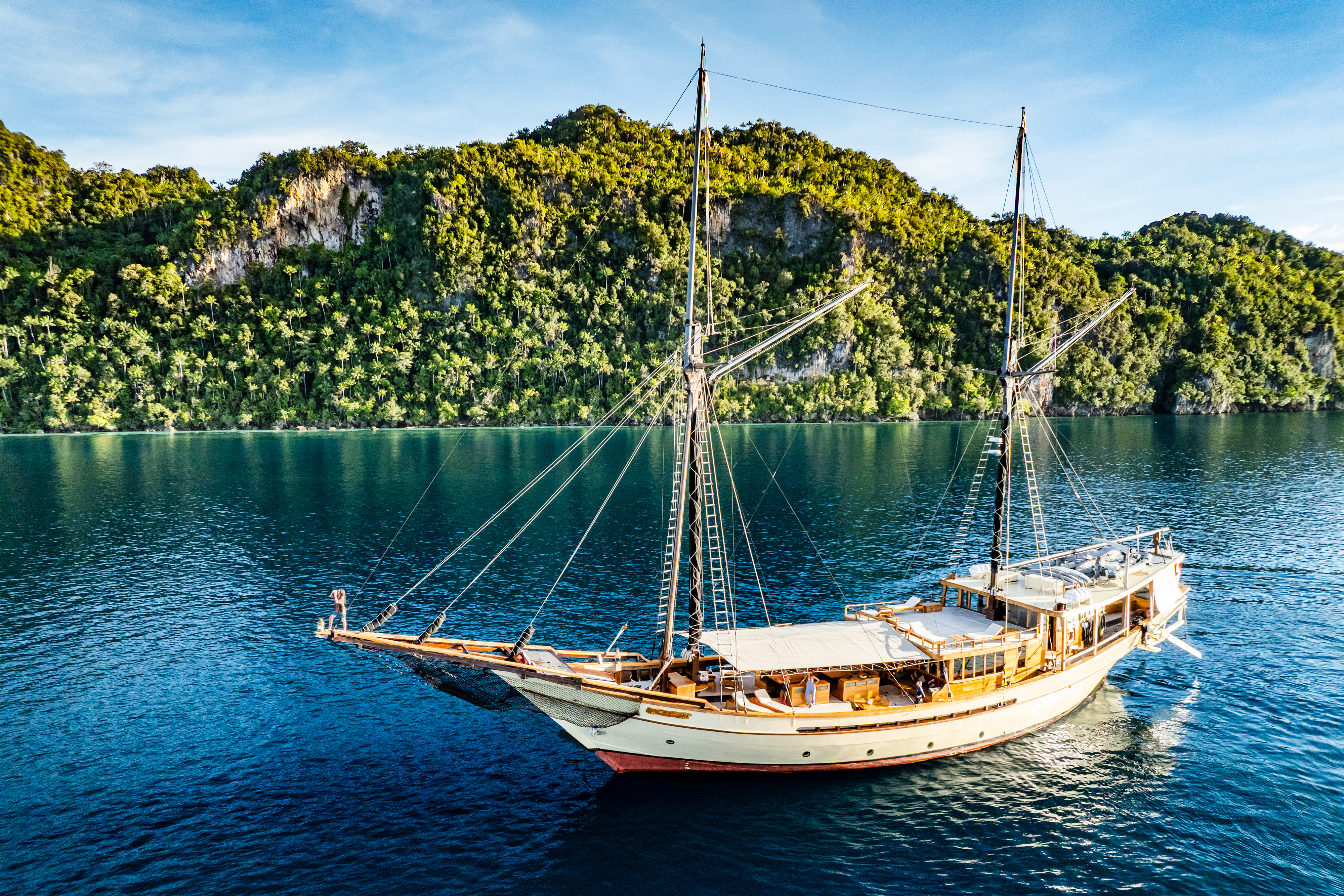
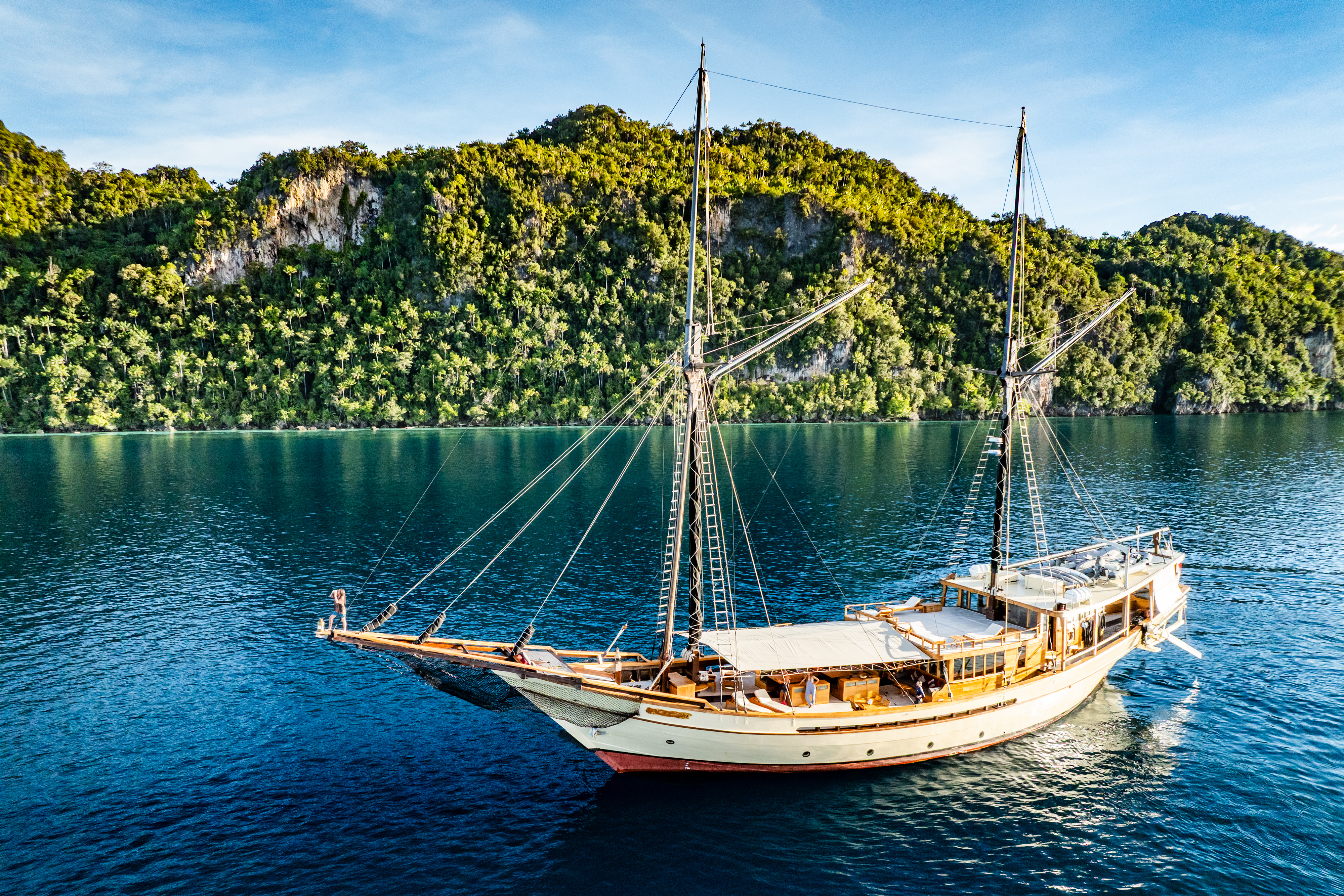
Dinner is wonderful. The stargazing after is wonderful, the Milky Way over a dark anchorage with no competing light for a hundred miles. But the hour before dinner is the one guests describe to friends, and it is worth being honest about why. It is the only part of the day that asks nothing of you. There is no dragon to hike toward, no reef to descend into, no village to visit with the care that visiting requires. The tenders are stowed. The plan is finished. For one compressed, saturated stretch of equatorial light, the entire apparatus of the journey exists to let you sit still on a hand-built wooden deck and watch a colour you cannot buy pass across the sky and leave.
That is the thing the ultra-rich traveller recognises and cannot manufacture at home: not the view, which exists in many places, but the arrangement of privacy, timing, and knowledgeable attention that lets the view land without interruption. You are anchored somewhere most people will never reach, on a boat that took a village of Sulawesi craftsmen to build, with a crew who have chosen this cove for this evening on purpose. The light does the rest.
With Silolona Sojourns, this hour is not an add-on to the itinerary; it is the quiet spine the rest of the day hangs from. Whether you sail Komodo in the dry months from May to September, or head east to Raja Ampat and the historic Banda spice islands from October to April, the same ritual finds you: engines off, deck turned west, a glass set down before you asked. To sail aboard Silolona and Si Datu Bua, or to plan a private journey shaped around the light rather than the checklist, you are warmly invited to enquire.
References
Corfidi SF. The colors of sunset and twilight. National Oceanic and Atmospheric Administration, Storm Prediction Center. Available from: https://www.spc.noaa.gov/publications/corfidi/sunset/
Veron JEN, Devantier LM, Turak E, et al. Delineating the Coral Triangle. Galaxea J Coral Reef Stud. 2009;11(2):91-100. doi:10.3755/galaxea.11.91
UNESCO. Pinisi, art of boatbuilding in South Sulawesi. Representative List of the Intangible Cultural Heritage of Humanity; 2017. Available from: https://ich.unesco.org/en/RL/pinisi-art-of-boatbuilding-in-south-sulawesi-01197