

Dinner at Anchor: The Culinary Philosophy of Silolona's Private Chef
The question is not whether a private yacht in Indonesia can feed you well. It is whether the kitchen onboard understands where you are. On a phinisi anchored in the Banda Sea or off a reef in Raja Ampat, the most revealing thing on the table is not the plate count or the wine list. It is the relationship between what you eat tonight and what the sea gave up this morning. This is the heart of dining onboard Silolona, and it is the work of Chef Ketut, whose approach to a luxury dining yacht Indonesia experience begins not with a fixed menu but with a question: what did the fishermen bring in today?
That question reorders everything. It is the reason no two evenings at anchor taste the same.
The Menu Is Written by the Morning, Not the Month
Most charter operators print a menu in advance and source backward to fill it. Chef Ketut works the other way around. Each day begins with the catch, often bought directly from local fishermen who paddle dugout canoes to the vessel. In the Banda Islands, that might mean large tuna pulled from the deep water near Batu Kapal, cut into sashimi before the breakfast service has cleared. Off Komodo, it could be a reef-caught fish that becomes the center of an evening grill on the aft deck under the Milky Way.
This is not improvisation for its own sake. It is a discipline built around freshness and proximity. An Indonesian chef onboard phinisi working this way accepts a harder job than a chef with a stocked freezer and a laminated card. The reward is a table that tells you, without a word, exactly where the vessel is sitting tonight.
Researchers studying food and travel have a name for this. They describe local cuisine as a source of epistemic value, a way for the traveler to discover a region's customs, history, and rhythm through what is on the plate.¹ A morning catch turned into dinner is that idea made literal.
Place Belongs on the Plate
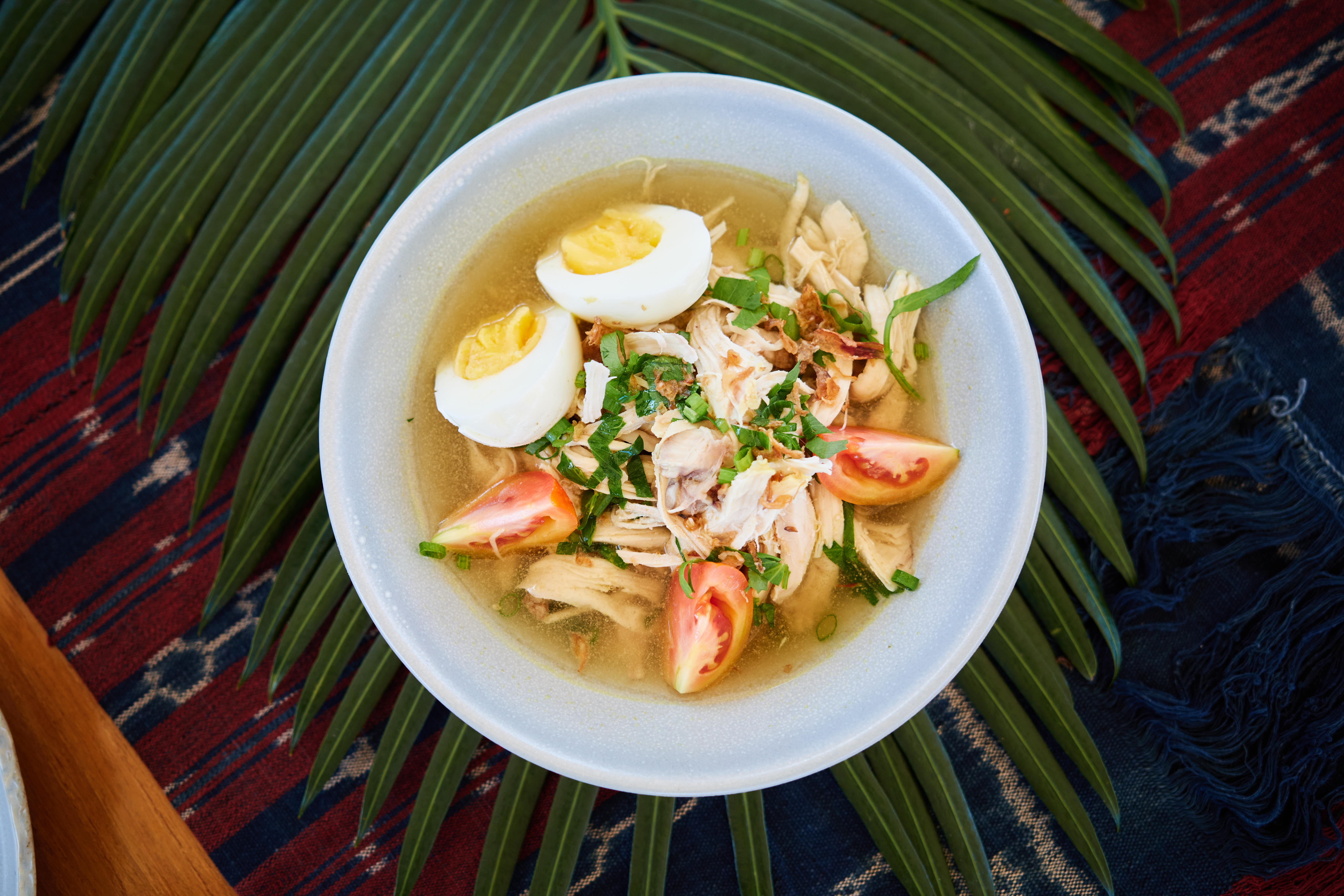
Indonesia is not one cuisine, and Silolona's route does not pretend it is. The kitchen shifts with the geography. In Banda, the menu leans into the Spice Islands themselves, the nine small islands that were once the world's only source of nutmeg and mace, fought over for centuries by Portuguese, Dutch, and English traders. A Bandanese fish curry here is not a flourish. It is a direct line to the gardens of Pulau Lonthor, where the world's oldest nutmeg trees still grow in the rich volcanic soil under ancient kenari almond canopies.
Sail north toward Sulawesi and the register changes again, toward the bright, chili-forward Manadonese cooking of the island's north, where heat and acidity carry the dish. The kitchen draws on Asian, fusion, and Western traditions, but the anchor point is always local: fresh tropical fruit, organically grown vegetables, freshly caught seafood, and breads and pastries made onboard rather than carried aboard.
Scholars of destination dining describe exactly this practice. They call it putting place on the plate, the deliberate use of local produce, recipes, and culinary knowledge to express where a guest actually is rather than a generic idea of fine dining.² For a traveler who has eaten well everywhere, this is the rare thing money alone cannot buy in advance. It has to be cooked in the moment, in the place.

Consultation Comes Before the First Course
The kitchen does not guess. Before a voyage takes shape, and through the days that follow, the chef consults directly with guests. Preferences, restrictions, and curiosities are gathered early and revisited as the trip moves. A guest who wants to lean into Indonesian flavors can be taken deep into them. A family that needs gentler, more familiar plates for younger travelers is read just as carefully. Dietary requirements, from allergies to specific ways of eating, are accommodated as a matter of course rather than treated as an exception.
This is where the difference between catered and considered becomes obvious. An all-inclusive operator offers abundance. A considered kitchen offers attention. The distinction matters most to travelers who have long since stopped being impressed by quantity and now notice only whether someone was paying attention to them specifically.
A typical day at anchor moves in clear stages. An alfresco breakfast on the teak deck, often built around the morning's first fruit and fresh bread. A generous brunch or lunch after the day's first dive or shore walk. Sunset cocktails on the aft deck, sometimes accompanied by sashimi cut from a fish landed hours earlier. Then dinner served under the stars, the meal that most directly carries the signature of wherever the vessel has anchored for the night. Occasionally the evening moves ashore entirely, to a barbecue or a bonfire on an empty beach.
Why Sourcing Is the Real Statement
It would be easy to read all of this as charm. It is closer to a philosophy. Buying from the fishermen who work these waters, cooking what the season and the tide actually offer, and shaping each menu to the island outside the porthole is a quieter and more durable kind of quality than any imported delicacy. It ties the meal to the community and the place that produced it, which is precisely what researchers identify as the deepest form of culinary value for the traveler who is looking for meaning rather than novelty.³
There is also an honesty in it. A kitchen built on the morning catch cannot promise a specific fish on a specific night, and it does not try to. What it promises instead is that whatever reaches the table will be fresh, will belong to where you are, and will have been considered for the people at the table. For a certain kind of traveler, that promise is worth more than a guarantee ever could be.
The plate, in the end, is a form of navigation. It tells you where you are.
Dining onboard is not a service that runs alongside the voyage. It is part of how the voyage is understood. Chef Ketut's kitchen reads the sea each morning, reads the island each evening, and reads the guests throughout, then turns all three into something that could not have been printed in advance. The result is not abundance for its own sake. It is precision, place, and attention, served at anchor.
With Silolona Sojourns, the table becomes another way to travel. AboardSilolona and Si Datu Bua, the kitchen follows the route through theSpice Island of Banda, across the reefs ofRaja Ampat, and into the bays ofKomodo, shaping each menu to the water outside and the people at the table. To begin planning a voyage built as carefully around the kitchen as around the dive sites,enquire withSilolona Sojourns.
References
Björk P, Kauppinen-Räisänen H. Local food: a source for destination attraction. International Journal of Contemporary Hospitality Management. 2016;28(1):177-194. Available from: https://doi.org/10.1108/IJCHM-05-2014-0214
Production of locality in destination restaurants: putting place on the plate. Foods. 2024. Available from: https://www.ncbi.nlm.nih.gov/pmc/articles/PMC11203273/
Tourists' local food consumption: travel experience, responsible tourism, or both? International Journal of Gastronomy and Food Science. 2025. Available from: https://doi.org/10.1016/j.ijgfs.2025.101230