

Slow Travel at Sea: Why Indonesia Is Meant to Be Explored at Phinisi Pace
On the third morning of a Komodo passage, guests stop asking what time it is. They have already learned that the answer does not matter. The coffee arrives when the light does. The tender leaves when the tide is right, not when a schedule says so. Somewhere between waking on a wooden deck and watching a headland slide past at the pace of a slow walk, the internal clock that governs most of their year quietly stops ticking. This is the real beginning of slow travel Indonesia sailing, and it is the thing no itinerary can promise in advance, only make possible.


For travelers in the United States and Europe who have grown tired of checklist tourism, the appeal is not more. It is less, done properly. Silolona moves through the archipelago at six to eight knots under working conditions, slow enough that a coastline changes character while you watch it: dry savannah giving way to mangrove, limestone karst rising where the beach ended. A resort itinerary measures a trip in destinations visited. A private phinisi measures it in hours spent actually present in one place. That difference is the whole argument, and it is what a mindful, high-end yacht journey delivers that a packed regional tour cannot.
Speed is the thing money usually buys. Here it is the thing you give up.
Most premium travel sells acceleration. Faster transfers, private terminals, the helicopter that skips the traffic. The logic is sound when the goal is to compress dead time. It becomes self defeating the moment the point of the trip is the passage itself. You cannot fast forward through the Coral Triangle and claim to have seen it.
Silolona was built in 2004 by Master Konjo boat builders of Sulawesi, to German Lloyds specifications, from tropical hardwoods, a 50 metre vessel carrying seventeen crew for as many as ten guests. Si Datu Bua, at 40.20 metres, carries fourteen crew for up to six, and the two together open eight cabins for a tandem journey. None of those numbers exist to move you quickly. They exist to make a slow passage comfortable enough that you stop wishing it were faster. The distinction matters to a certain kind of traveler: the crew ratio is not there to serve you more efficiently, it is there so that nothing about the day requires your attention unless you want it to.
What actually changes when the pace drops
There is a measurable psychology to this, not just a mood. Attention restoration research has long held that natural environments let the mind recover a kind of focus that cities deplete, and that the recovery depends on duration and immersion rather than novelty.¹ A phinisi passage is almost a controlled experiment in that idea. Days three through six are when guests report the shift most often: sleep deepens, appetite resets to the rhythm of the sea, and the compulsion to document every moment fades into the simpler act of watching.
The village call illustrates it better than any theory. On a resort schedule, a cultural stop is forty minutes, a photograph, a purchase, a return to the bus. On Silolona, the yacht can hold an anchorage because there is nowhere it needs to be by nightfall. That single fact changes the encounter. You stay long enough for the initial performance of hospitality to relax into something ordinary and real. In the Banda Islands, that might mean an afternoon in a nutmeg garden rather than a lap of Fort Belgica; the tradition of these islands, and the phinisi that carried spice through them, belongs to a maritime culture that South Sulawesi still practises and that UNESCO recognises as intangible heritage.² Depth is not a marketing word here. It is a function of time, and time is what the vessel is designed to give you.
Depth over breadth, in the specific rather than the abstract
Consider two ways to spend a week in Raja Ampat. The first visits eight sites in seven days, a reef here, a viewpoint there, a village in between, each ticked and left behind. The second anchors near Misool and stays. On the slower version you dive the same wall at three different states of tide and learn that it is three different reefs. You notice which cleaning station the mantas return to. You watch a single lagoon change colour through a full day. Raja Ampat holds more than six hundred islands, roughly 1,200 species of fish and 540 species of coral, and the paradox of such richness is that hurrying past it registers as almost nothing.³ Abundance rewards patience and punishes speed.
The resort mentality treats an archipelago as a list of assets to be collected. It is a reasonable way to see famous things and a poor way to understand a place. Silolona's crew, many of whom have sailed these waters for years and some of whom, like Goris Atawuwur of Flores, helped build the vessel and now guide beneath it, tend to steer guests toward the encounter that stays with them rather than the one that photographs best. Dinner might be sashimi from a fish caught that afternoon, or bread and pastry baked on board that morning by a galley that treats Bandanese and Manadonese cooking as seriously as anything European. Whatever you want to call the value of it, it lives in the restraint: fewer places, entered more completely.
The trip you remember is rarely the one you rushed
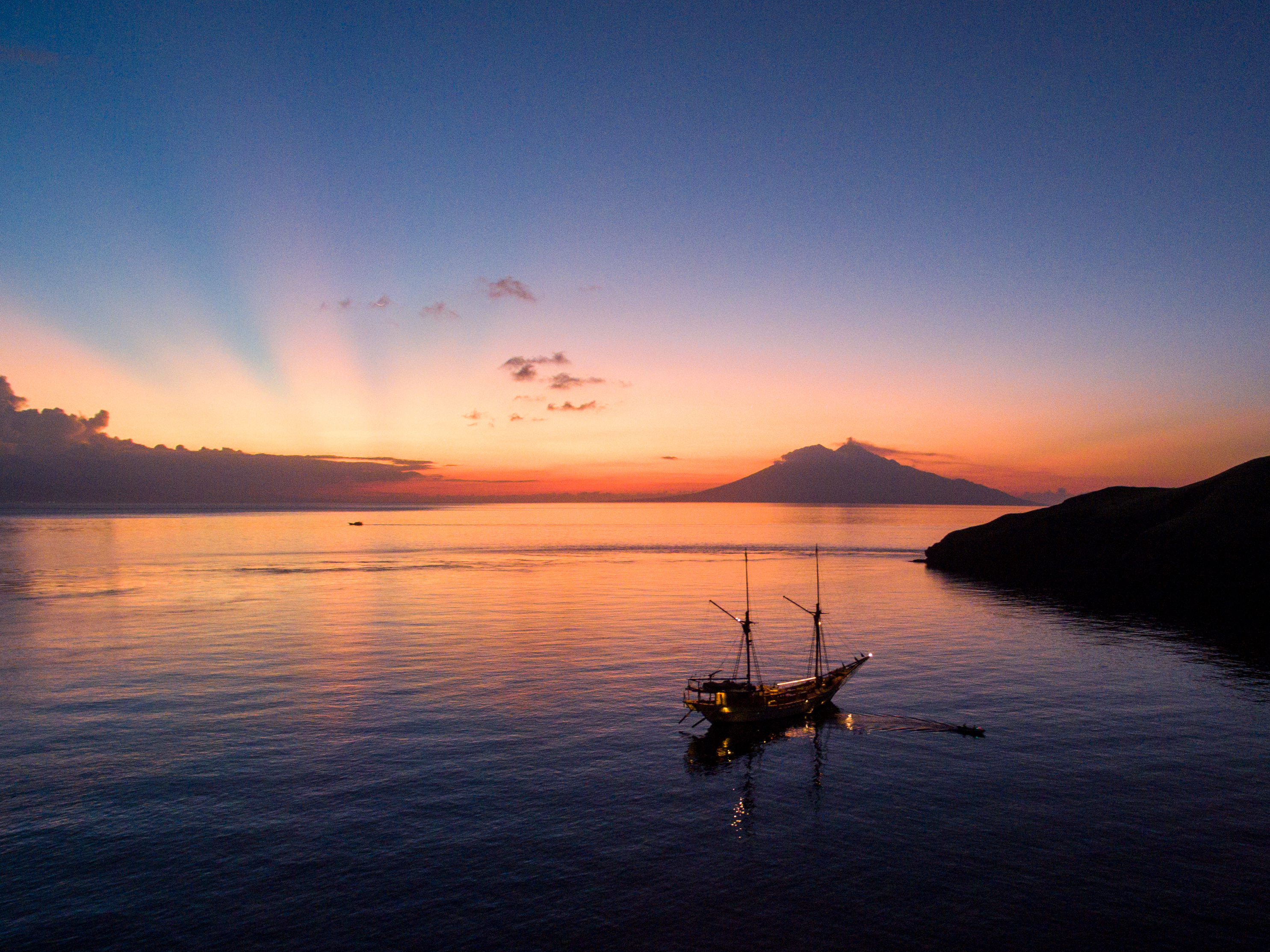
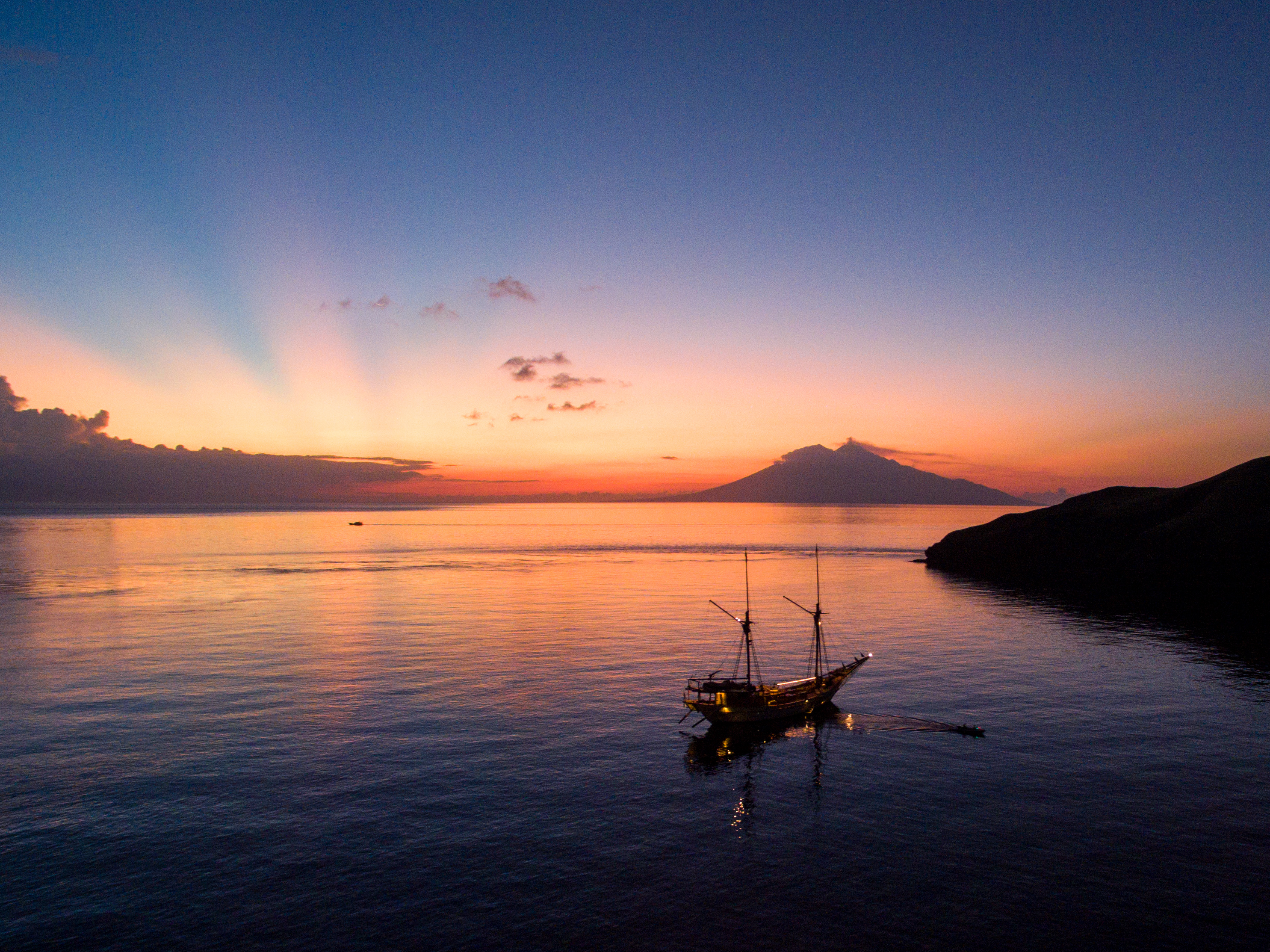
Checklist travel is optimised for the story you tell afterward, the map with pins in it. Slow travel is optimised for the version of yourself that returns. Guests who came aboard intending to see Komodo, Rinca, and four dive sites often leave describing a single evening at anchor, the engines off, the Milky Way overhead, no other vessel in sight. That was never on the itinerary. It could only happen because the itinerary was willing to yield to the day.
The philosophy is simple and slightly against instinct: you will remember Indonesia more clearly for having seen less of it. The phinisi, moving at the pace of the wind and the tide, is the instrument that makes that possible. It does not carry you through the archipelago. It lets the archipelago arrive.
With Silolona Sojourns, a journey through Komodo, Raja Ampat, or the Banda spice islands is shaped around the sea, the season, and the kind of memory you actually want to keep, aboard Silolona and Si Datu Bua. If a quieter, deeper way of entering Indonesia is what you are after, you are warmly invited to enquire.


References
- Kaplan S. The restorative benefits of nature: toward an integrative framework. J Environ Psychol. 1995;15(3):169-182. doi:10.1016/0272-4944(95)90001-2.
- UNESCO. Pinisi, art of boatbuilding in South Sulawesi. Representative List of the Intangible Cultural Heritage of Humanity; 2017. Available from: https://ich.unesco.org/en/RL/pinisi-art-of-boatbuilding-in-south-sulawesi-01197
- Veron JEN, Devantier LM, Turak E, et al. Delineating the Coral Triangle. Galaxea J Coral Reef Stud. 2009;11(2):91-100. doi:10.3755/galaxea.11.91.