

Stargazing at Sea: Why Remote Indonesian Waters Offer Some of Earth's Darkest Skies
The question is not whether the stars are out tonight. They are always out. The question is whether anything is in the way, and for most of the people who can afford to go anywhere, the answer at home is everything. City glow, suburban sprawl, the permanent amber haze that has erased the Milky Way for most of the developed world. A stargazing yacht Indonesia voyage solves this in the most direct way possible. It removes you from the light. Anchored in a bay in eastern Indonesia where nothing on the horizon glows but the water itself, you are sitting under one of the last genuinely dark skies left on the planet. Dark sky sailing eastern Indonesia is not a gimmick added to the itinerary. It is a consequence of where the boat goes.
The sky you grew up being told existed is real. You have just never been somewhere dark enough to see it.
What "Dark" Actually Means, and Why It Is Rare
Astronomers measure sky darkness on the Bortle scale, a nine-step system published in 2001 that runs from Class 1, the pristine skies where the Milky Way casts a faint shadow on the ground, to Class 9, the washed-out orange of an inner city.¹ Roughly 99 percent of people in the United States and Europe live under skies polluted enough that the Milky Way is invisible. Most will never stand under anything darker than Class 5.
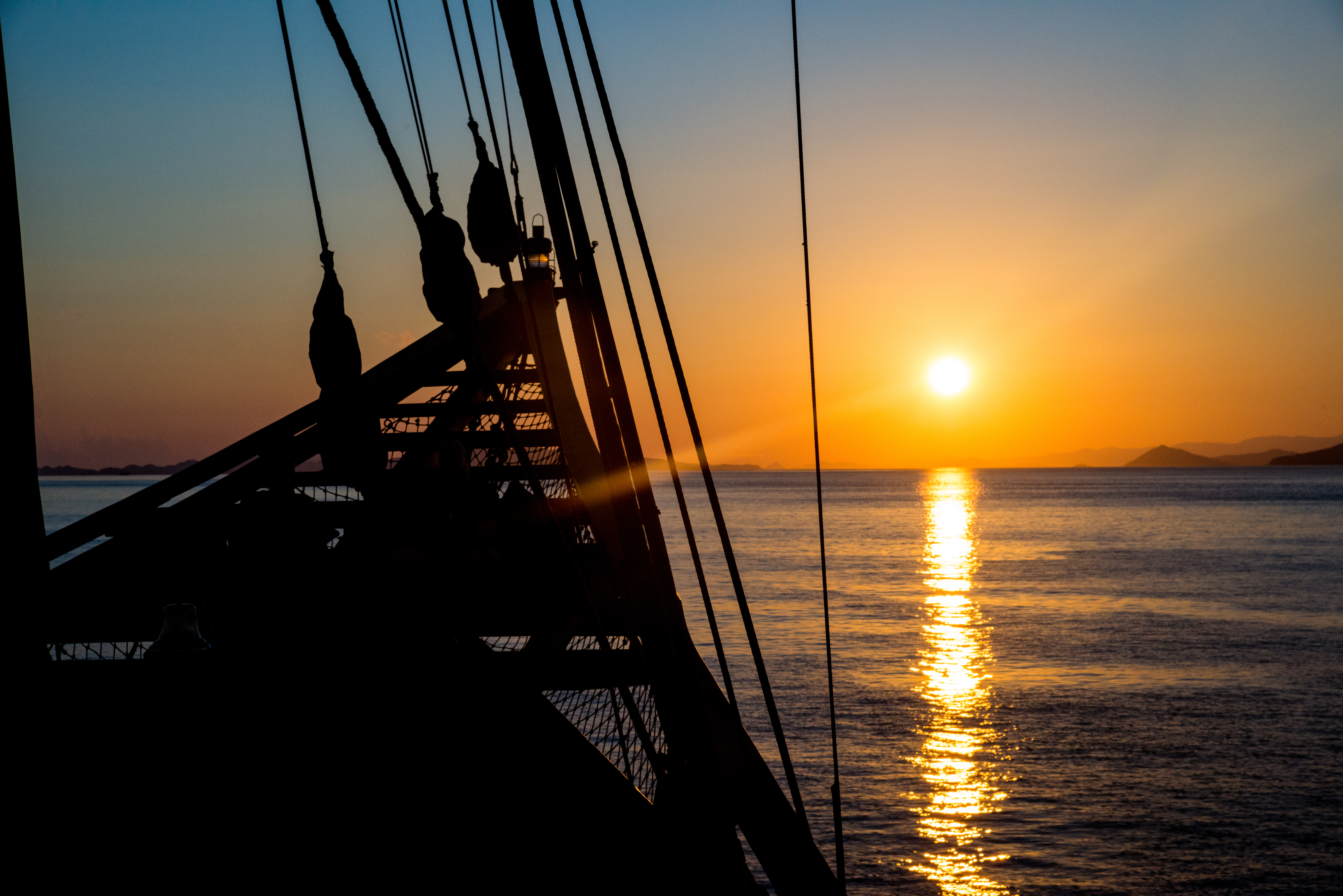
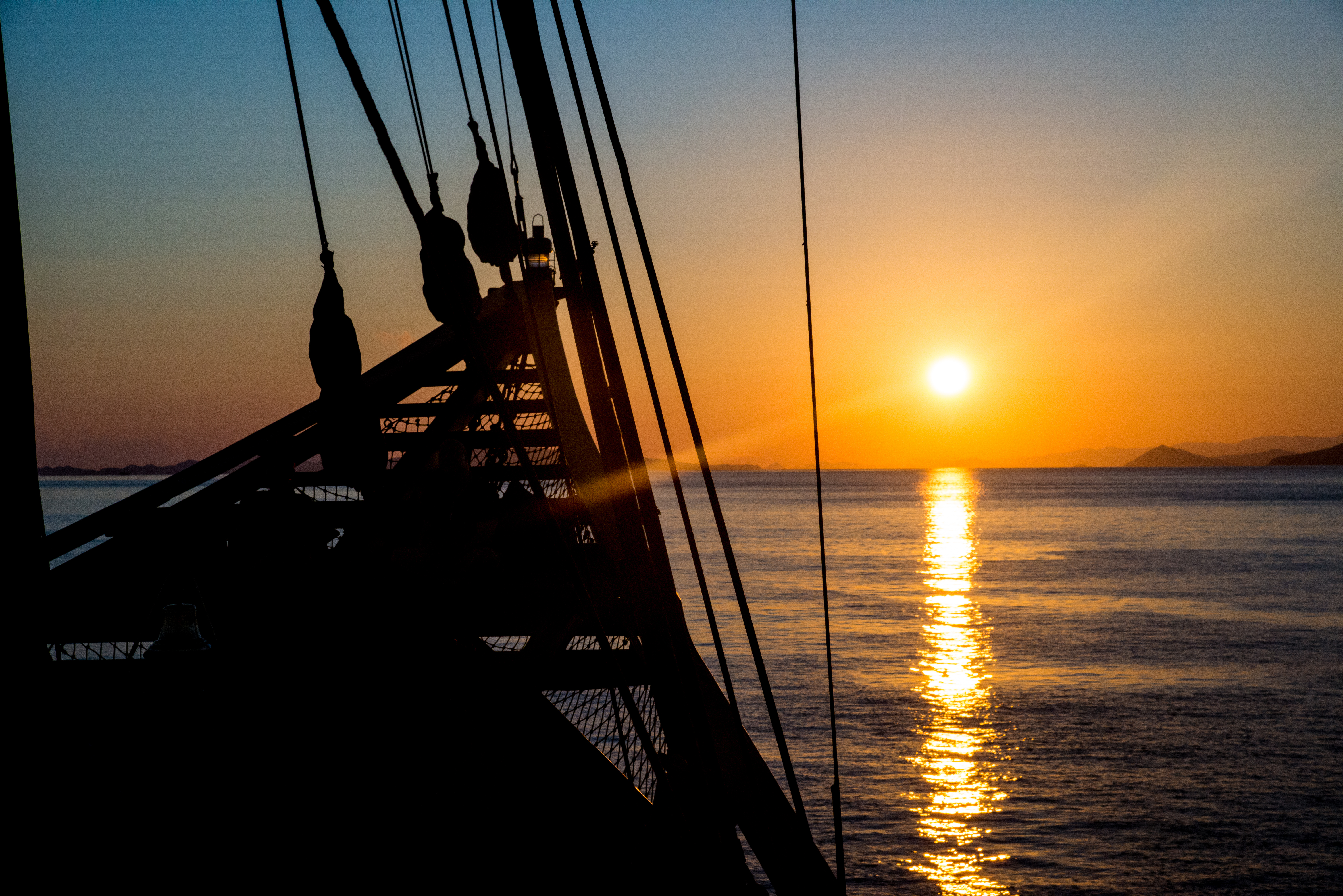
The anchorages on a voyage through remote eastern Indonesia sit at the opposite end of that scale. With no settlement for miles and only open sea in every direction, these waters approach the darkest classes the scale describes, the rare low-single-digit skies where the band of the galaxy is not a faint smudge but a structured arc of light overhead. The official Silolona record of nights in the Komodo region describes dinner on deck under the brilliant stars of the Milky Way, with shooting stars and the glitter of phosphorescence on the water. That is not marketing language. That is what a Class 2 or 3 sky looks like from the deck of a boat.
You do not need a telescope here. You need only to look up.
The Sky Has Seasons, and the Boat Follows Them
A dark sky is necessary but not sufficient. What you see also depends on when you sail, and the southern view from Indonesia changes through the year.
Sail the Komodo region between May and September, the dry season for those islands, and you are under the clearest, most stable skies of the southern winter, when the bright core of the Milky Way rides high overhead in the evening. The Southern Cross is easy to find, and the two Magellanic Clouds, the satellite galaxies that never clear the horizon for most of the northern hemisphere, sit well clear of it here. Several of the year's reliable meteor showers fall in this window. The Eta Aquariids, born of Halley's Comet, peak in early May and favor the southern hemisphere, where the radiant climbs high before dawn. The Southern Delta Aquariids follow in late July, another shower best seen from the southern tropics in the dark hours after midnight. The Perseids peak in mid-August, lower in the sky from this latitude but still active.
Shift east to Raja Ampat and the Banda Sea between October and April and the calendar offers its own events: the Orionids in October, also from Halley's Comet; the Geminids in December, often the most prolific shower of the year; and the Quadrantids in early January, intense but brief, and better placed for northern skies than for ours. These are guidance, not guarantees. Cloud, moon phase, and sea state all have a vote, and any honest operator will tell you so.
The point is that the timing is plannable. The weather is not.
How Silolona Reads the Conditions
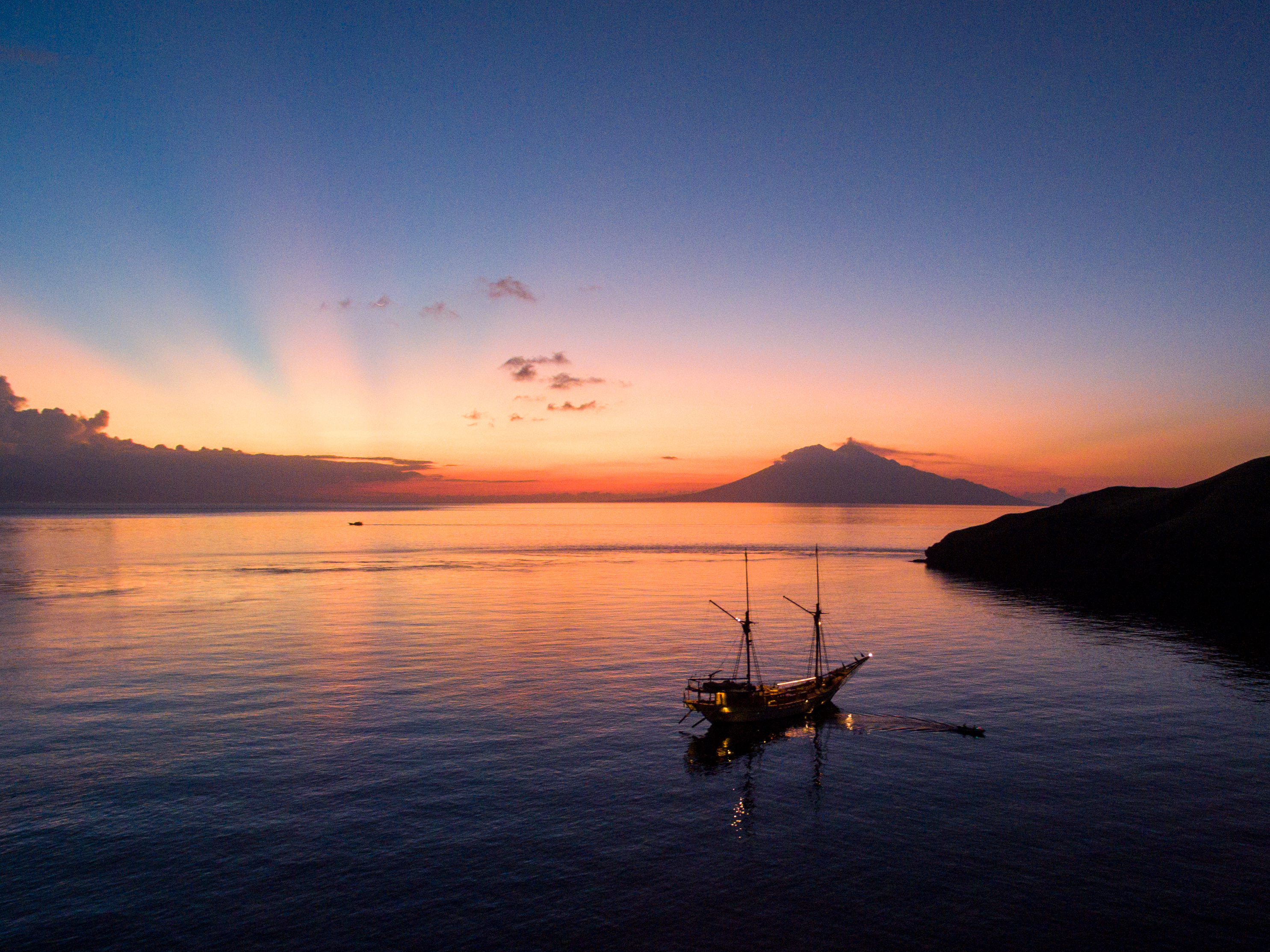
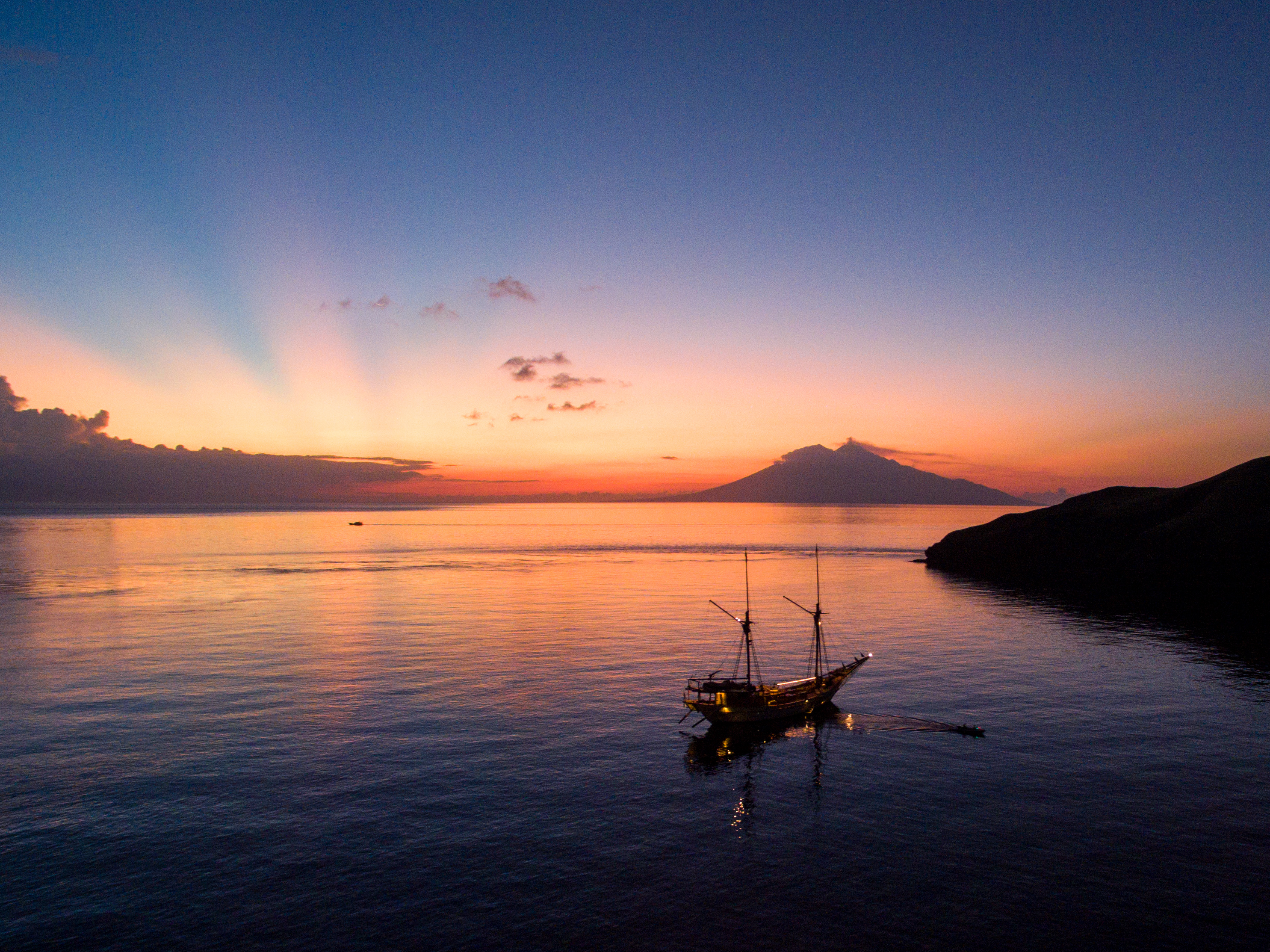
This is where a private vessel changes the equation. A fixed observatory cannot move. A boat can. When the goal is the sky, the expedition leader can plan the evening anchorage around it, choosing a bay sheltered from wind for a steady horizon, timing the approach so the boat is settled and the deck lights dimmed before the sky fully darkens, and reading the moon phase so the best viewing falls on the nights the moon is down.
The deck itself helps. With the vessel's lights lowered and nothing but black water around you, your eyes adapt fully, and full dark adaptation is what separates a good night sky from an unforgettable one. Maritime Starlink means you can pull up a sky chart to find a planet or a cluster, then put the screen away and let the real thing take over. None of this is guaranteed against a cloudy night. All of it stacks the odds in your favor in a way no land-based site can match, because the boat can simply be somewhere better.
Conditions permitting, the best seat for the Milky Way is a deck chair and a clear horizon. You already have both.
The Oldest Reason to Watch These Skies
There is a deeper resonance to stargazing in these particular waters, and it is not decorative. The phinisi you are sailing on descends from the boatbuilding tradition of South Sulawesi, the craft of the Bugis, recognized by UNESCO as intangible cultural heritage of humanity. The Bugis were among the most accomplished seafarers in the history of the archipelago, and long before compass or satellite, they navigated these same seas by the stars.²
Their knowledge was specific and hard-won. Rising and setting points of particular stars marked direction. The seasonal position of constellations marked the calendar and the safe sailing windows. The same sky you are admiring from a deck chair was, for centuries, a working instrument, read by men crossing open water to the Spice Islands and beyond. When you look up from a Silolona deck, you are not just sightseeing. You are looking at the chart your vessel's ancestors actually used.
That history is why dark-sky travel here means more than a good photograph. It connects a modern night under the stars to a living maritime culture, the kind of layered, place-rooted experience that astrotourism at its best is built to offer.³ The stars over the Banda Sea are the same ones the Bugis steered by. You are simply reading them for pleasure now, not survival.
The darkest skies left on Earth are not in a national park you can drive to. They are over open water, far from any light a road or a town could throw, and the most reliable way to reach them is a vessel that can carry you there and then choose exactly where to anchor for the night. Eastern Indonesia offers the rare combination of near-zero light pollution, a rich southern sky that changes with the season, and a seafaring heritage that read those same stars for a thousand years. A private boat is the one platform that lets you meet all three at once. The sky was always there. This is how you finally get under it.
With Silolona Sojourns, the night sky becomes part of the route rather than an afterthought. AboardSilolona and Si Datu Bua, the expedition team can shape your anchorages inKomodo or the remote reaches ofRaja Ampat around the clearest skies and the season's strongest celestial events, conditions allowing. To begin planning a voyage built around the stars and the Bugis seas that taught the world to read them,enquire withSilolona Sojourns.
References
Bortle JE. Introducing the Bortle dark-sky scale. Sky & Telescope. 2001;101(2):126-129. Available from: https://skyandtelescope.org/astronomy-resources/light-pollution-and-astronomy-the-bortle-dark-sky-scale/
Raysid A, Orchiston W, Hamacher D, et al. Star patterns in Mandar navigation. In: Orchiston W, Vahia MN, editors. Exploring the History of Southeast Asian Astronomy. Cham: Springer; 2021. p. 549-565. Available from: https://doi.org/10.1007/978-3-030-62777-5_19
Weaver D. Celestial ecotourism: new horizons in nature-based tourism. Journal of Ecotourism. 2011;10(1):38-45. Available from: https://doi.org/10.1080/14724040903576116
American Meteor Society. Meteor Shower Calendar 2026–2027 [Internet]. Available from: https://www.amsmeteors.org/meteor-showers/meteor-shower-calendar/
International Meteor Organization. 2026 Meteor Shower Calendar [Internet]. Available from: https://www.imo.net/resources/calendar/
Royal Museums Greenwich. Eta Aquariid meteor shower 2026: when and where to see it [Internet]. Available from: https://www.rmg.co.uk/stories/space-astronomy/eta-aquariid-meteor-shower-2026-when-where-see-it-uk
Natural History Museum. Meteor showers: when is the next one and how to see it [Internet]. Available from: https://www.nhm.ac.uk/discover/meteor-shower-lyrids-perseids-geminids-leonids-orionids.html