

The Banda Neira Archipelago: A Private Voyage Into the Original Spice Islands
Some Destinations Are Beautiful. Banda Neira Is Significant.
There is a difference between a destination that impresses and one that quietly rearranges your understanding of the world. Banda Neira belongs emphatically to the second kind. Before you even sight land, the scent of nutmeg and clove drifts across miles of open sea, arriving on the bow of a tall wooden schooner before the islands themselves come into view. That arrival alone tells you something has changed.
Far out in the Banda Sea, beyond the archipelagos most travelers have already discovered, nine small volcanic islands carry a history wildly disproportionate to their size. They shaped empires, redirected trade routes, and once determined the boundaries of the known world. In 1667, under the Treaty of Breda, the Dutch retained the Banda Islands while England withdrew, accepting Manhattan in exchange. At the time, nutmeg made this seem like a reasonable trade.¹
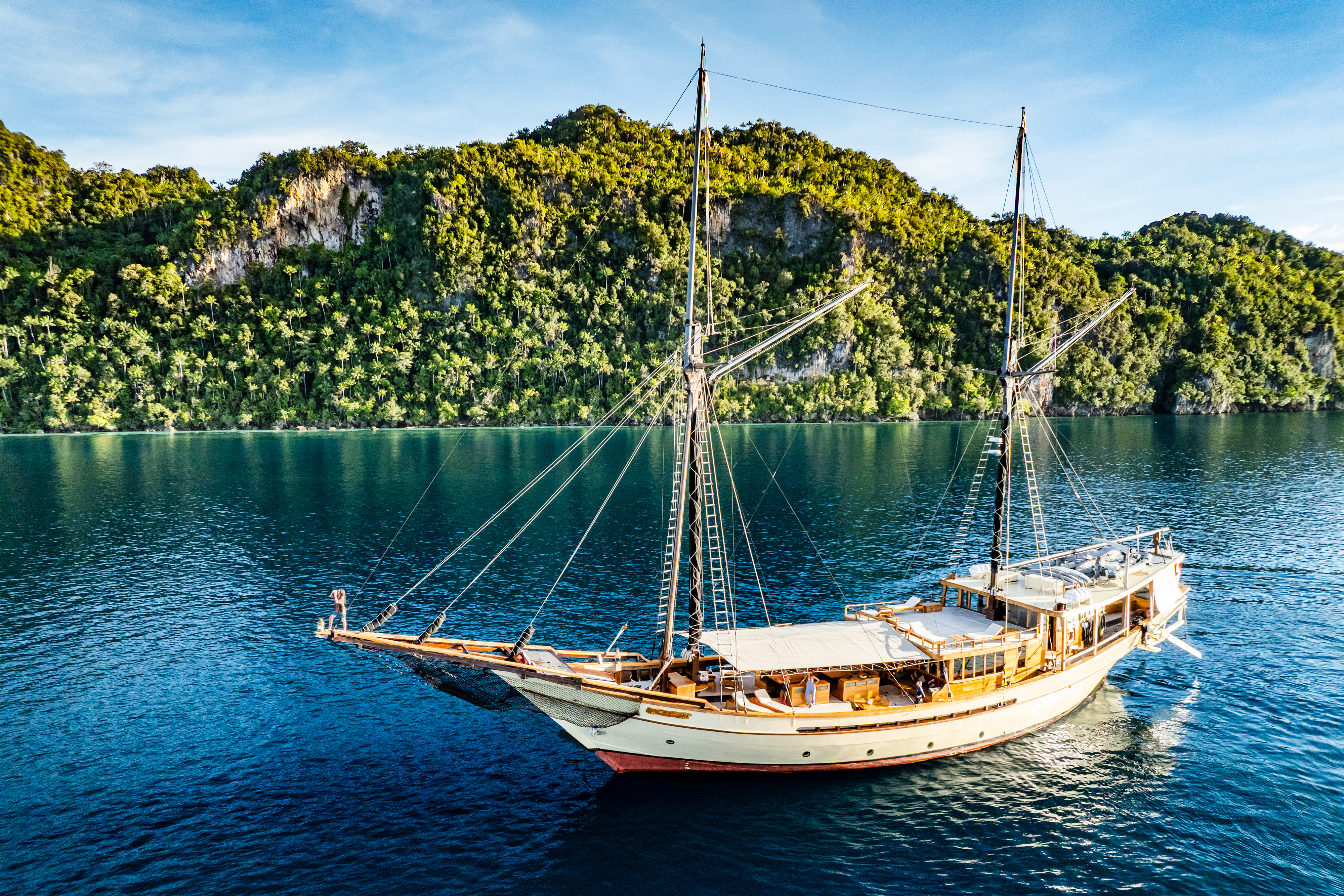
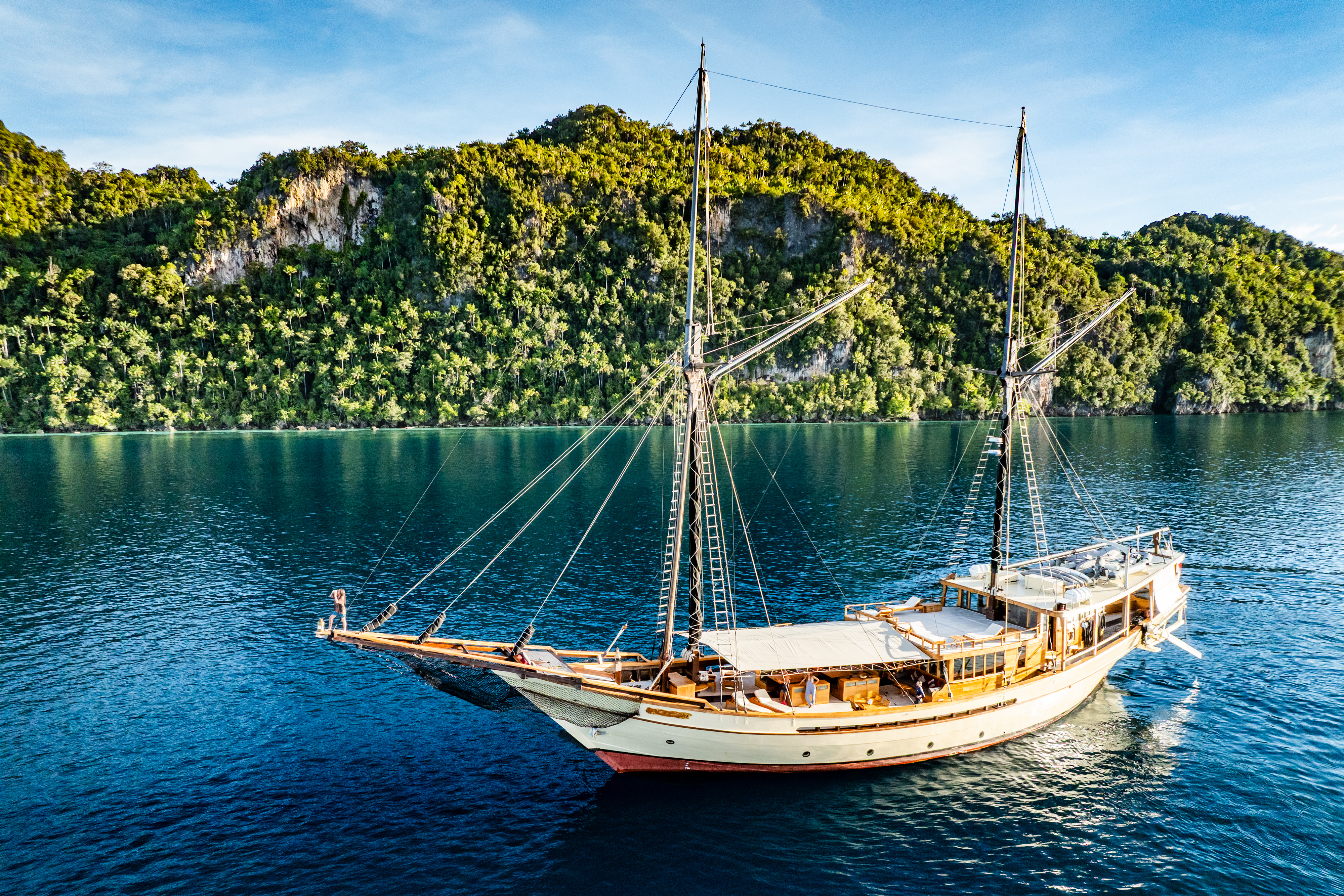
Banda Neira today is not a heritage theme park. It is a living, still-inhabited archipelago where forts stand over a working harbor, where nutmeg trees grow in the same volcanic soil they always have, and where the memory of extraordinary global ambition coexists with quiet daily life. A Banda Islands yacht charter with Silolona Sojourns is not merely a cruise through beautiful islands. It is a private passage into one of the world's most quietly consequential places, shaped by three decades of expedition expertise, intimate local access, and a vessel purpose-built for exactly this kind of journey.
Why Banda Neira Still Feels Like a Secret
Banda is not remote because it lacks importance. It is remote because it is protected by the very geography that made it so valuable: deep sea, seasonal winds, and long distances from Indonesia's more developed travel corridors. That isolation has preserved its atmosphere in a way that no amount of careful curation ever could.
For most travelers, this remoteness is a barrier. For Silolona guests, it is the entire point.
Arriving by private charter means the archipelago unfolds at its natural pace. You approach through the Zonnegat Passage as the first light catches the cone of Gunung Api rising from the sea. You step ashore when the morning is still cool. You walk the wide tree-lined streets of Banda Neira town before the equatorial heat settles. You return to the water, or to the teak decks, when you choose. No ground transfer schedules, no check-in times, no other guests.
For the culturally curious luxury traveler who values the weight of where they are over the loudness of the amenity list, Banda offers something increasingly rare: a place that has not been optimized for mass arrival.
The Spice Islands and the Price of Nutmeg
To understand Banda Neira, you must begin with nutmeg. Before modern agriculture and industrial shipping made spices ordinary, nutmeg was a luxury object with extraordinary economic power. It flavored elite kitchens across Europe, entered medicinal traditions, and moved through trade networks connecting Asia, the Middle East, and eventually every major maritime empire.
The Banda Islands became central to European competition because they were the world's sole natural source of both nutmeg and mace (the aril wrapped around the nutmeg seed). The VOC, the Dutch East India Company, pursued monopoly control here with consequences for Bandanese communities that contemporary scholarship continues to examine and reframe. Local voices, oral histories, and community resilience are increasingly understood as central to Banda's heritage, not footnotes to a European-centered narrative.²
That complexity is part of what gives Banda its depth. Walking here is not simply a scenic experience. The forts and the colonial mansions are not merely picturesque ruins. They are physical evidence of a global system built on desire, trade, and contested power. The most rewarding way to encounter them is slowly, with context, and with a guide who understands the full story, not just the Dutch chapter.
This is the kind of access Silolona Sojourns has cultivated over more than 30 years of expedition voyaging through these waters.
A Deeper Kind of Access
What separates a Silolona voyage to Banda from any other form of travel here is not simply comfort aboard; it is what opens ashore.
Silolona Sojourns founder Patti Seery's long association with the Banda Islands means guests gain access that is genuinely unavailable to independent travelers or group tour operators: private colonial mansions, normally closed to visitors, open their doors. Local guides who have known these islands for generations provide context no guidebook carries. The kinds of slow, human encounters that define a meaningful journey, in nutmeg gardens, in old lanes, in conversations that move from spice to family to land, become the texture of the trip rather than the occasional lucky moment.
One evening, guests dine in a private, partially restored Dutch mansion: a rijsttafel dinner of many local Indonesian dishes served in a setting that carries the weight of centuries. It is the kind of experience that does not exist on a menu anywhere. It exists because of relationships built over decades.
This is what Silolona means by expedition luxury: not louder amenities, but deeper access.
Fort Belgica at Sunset: Why the View Still Matters
Above the harbor of Banda Neira stands Fort Belgica, one of the most architecturally distinctive landmarks in Eastern Indonesia. The original fortification was ordered in 1611 after nearby Fort Nassau was judged strategically vulnerable. Later redesigns gave it the commanding five-bastioned form that still stands, with unobstructed sight lines across Banda Neira town, the island of Banda Besar, and the volcanic cone of Gunung Api.
From the ramparts at sunset, with cocktails and the day cooling around you, you understand immediately why this harbor mattered. The islands sit close enough to feel intimate. The surrounding sea suggests both shelter and exposure. In the 17th century, this view represented control over one of the most economically significant points on earth. Today, it invites something slower: the pleasure of knowing exactly where you are in history.
Banda's historic and marine landscape was added to Indonesia's UNESCO Tentative List in 2015, recognizing the combined cultural and natural value of the islands. For the serious traveler, this is confirmation of what is already apparent on arrival: Banda is layered in a way that rewards attention.
Reefs, Lava Flows, and the Banda Sea Underwater
Banda's history may draw you above water. Its reefs may be what make you stay longer than you planned.
The Banda Sea sits within one of the world's most biodiverse marine regions. Research on the Sunda Banda Seascape identifies it as part of the global epicenter of marine biodiversity, with extensive marine protected areas and high conservation importance.³ Around the Banda Islands, volcanic geology creates unusually varied underwater habitats: steep drop-offs, nutrient-rich upwellings, seamounts, and wide coral walls.
On Day Three, the yacht anchors near Pulau Pisang, where schools of yellowfin tuna and swirling masses of barracuda drift past coral walls that drop to 70 meters, with visibility that can reach 40 meters. Snorkeling is exceptional for non-divers. At dusk, a short dive in the shallow waters off the waterfront reveals one of Banda's quieter spectacles: the mandarin fish, congregating at the edge of the reef in a display of color that most divers never know to look for.
One of the Banda Sea's most remarkable dive sites tells a story above water first. On 10 May 1988, Gunung Api erupted after centuries of dormancy, sending lava flows north from near the summit and into the sea. Today, the lava flows form one of the most visually striking dive environments in Indonesia, with giant sea fans and extraordinary coral growth set against black volcanic substrate. The rate of coral recovery here has drawn the attention of marine scientists for years. It is not a spectacle that can be manufactured. It is a consequence of the same geological forces that built these islands.
Sir Alfred Russel Wallace, the Victorian naturalist and co-author, with Darwin, of evolutionary theory, wrote of the reefs at Pulau Hatta in the mid-19th century, describing living coral and minute organisms visible through clear water at considerable depth. The reef he was looking at is still there. The visibility still holds.⁴
Specific dive conditions (visibility, temperatures, currents) vary by site, season, and day. Silolona's guides make site calls based on current conditions and guest experience. The Banda Sea is best approached with curiosity, not a checklist.
Pulau Run: The Island That Was Traded for Manhattan
Few historical curiosities in Indonesia are as quietly extraordinary as Pulau Run. Once among the most strategically valuable pieces of land on earth, as the sole source of nutmeg claimed by English colonists, it was surrendered to the Dutch in 1667 under the Treaty of Breda in exchange for English claims to New Amsterdam. The island that became Manhattan was traded for an island that today is home to one remaining family.
A full day's sail brings the yacht to Pulau Run, where the old church still stands and ruins of colonial mansions and nutmeg factories remain largely as the jungle left them. The diving at Pulau Run is also notable, with deep walls hosting substantial fish life, and the nearby island of Neilaka adding further options for divers who want to extend their time below.
There is something humbling about standing in a place that the world once thought worth fighting for, now returned almost entirely to silence.
The Gunung Api Ascent: Before Sunrise, Before Breakfast
On Day Five, the alarm sounds before dawn.
The hike to the summit of Gunung Api begins in darkness, up a slope of volcanic scree that is steeper than the modest 666-meter elevation suggests. It is a genuine climb, not technical, but requiring effort and care on the loose volcanic rock. Every bit of that effort is repaid at the summit, where the panorama opens across Banda Neira, the surrounding islands, and the full blue expanse of the Banda Sea at first light.
The descent returns guests to Silolona or Si Datu Bua for a swim and a breakfast that earns its place in the memory. Then the yacht sails for Pulau Hatta, where the diving offers some of the most dramatic drop-offs in the archipelago: deep walls, large schooling pelagic fish, and the particular clarity of Banda Sea water that Wallace was recording 150 years ago.
This is not a day at sea. It is a day that asks something of you, and gives considerably more in return.
Is This Voyage Right for You?
Silolona Sojourns represents a particular kind of travel. It is worth being direct about what that means.
Banda Neira rewards travelers who are drawn to historical depth, genuine cultural encounter, and the privilege of being somewhere that has not been designed for tourism. It suits guests who prefer the rhythm of the sea over the predictability of a resort itinerary, seeking two or three exceptional dives combined with a morning ashore in a nutmeg garden, rather than the maximum dive-per-day count that a dedicated liveaboard would offer.
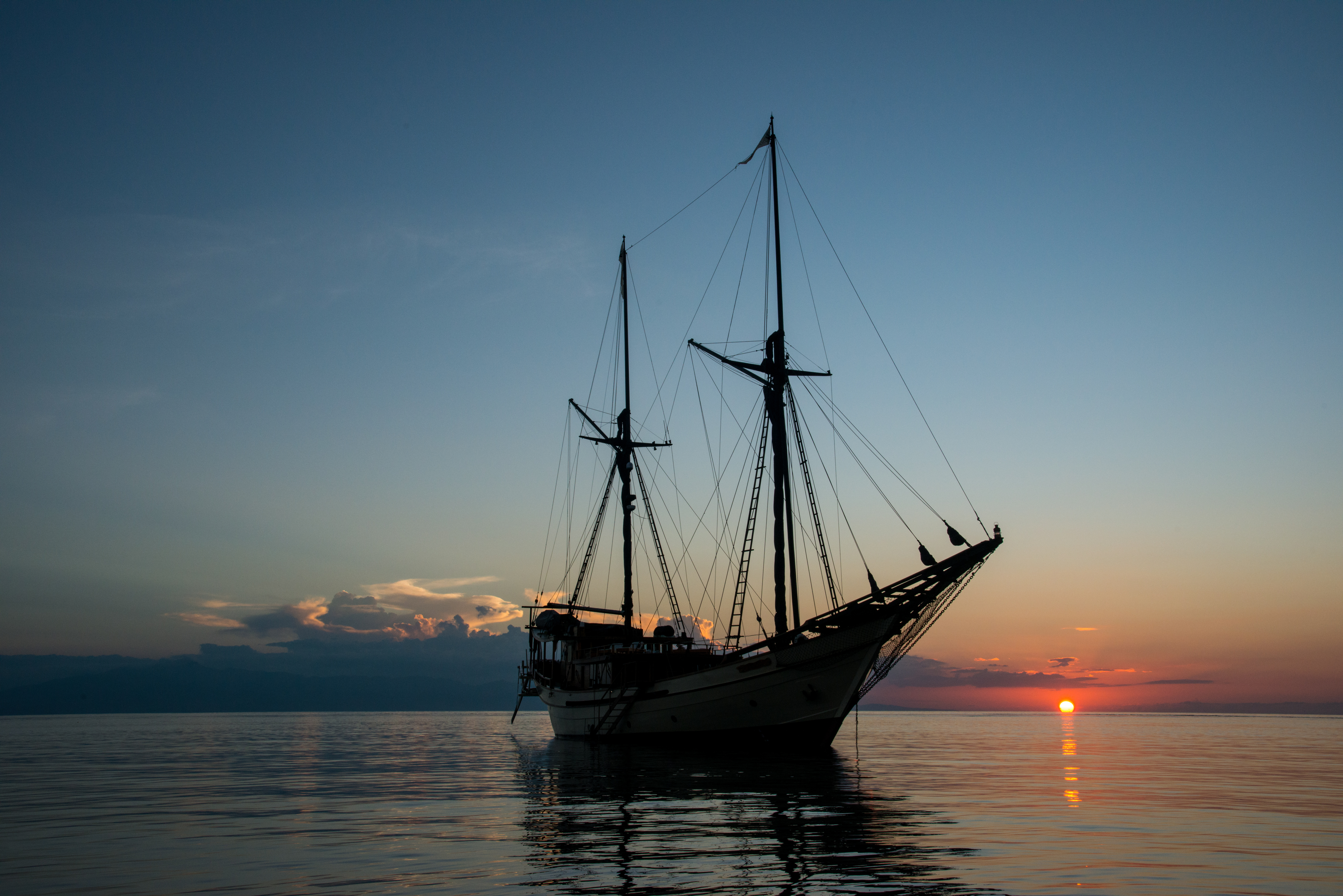
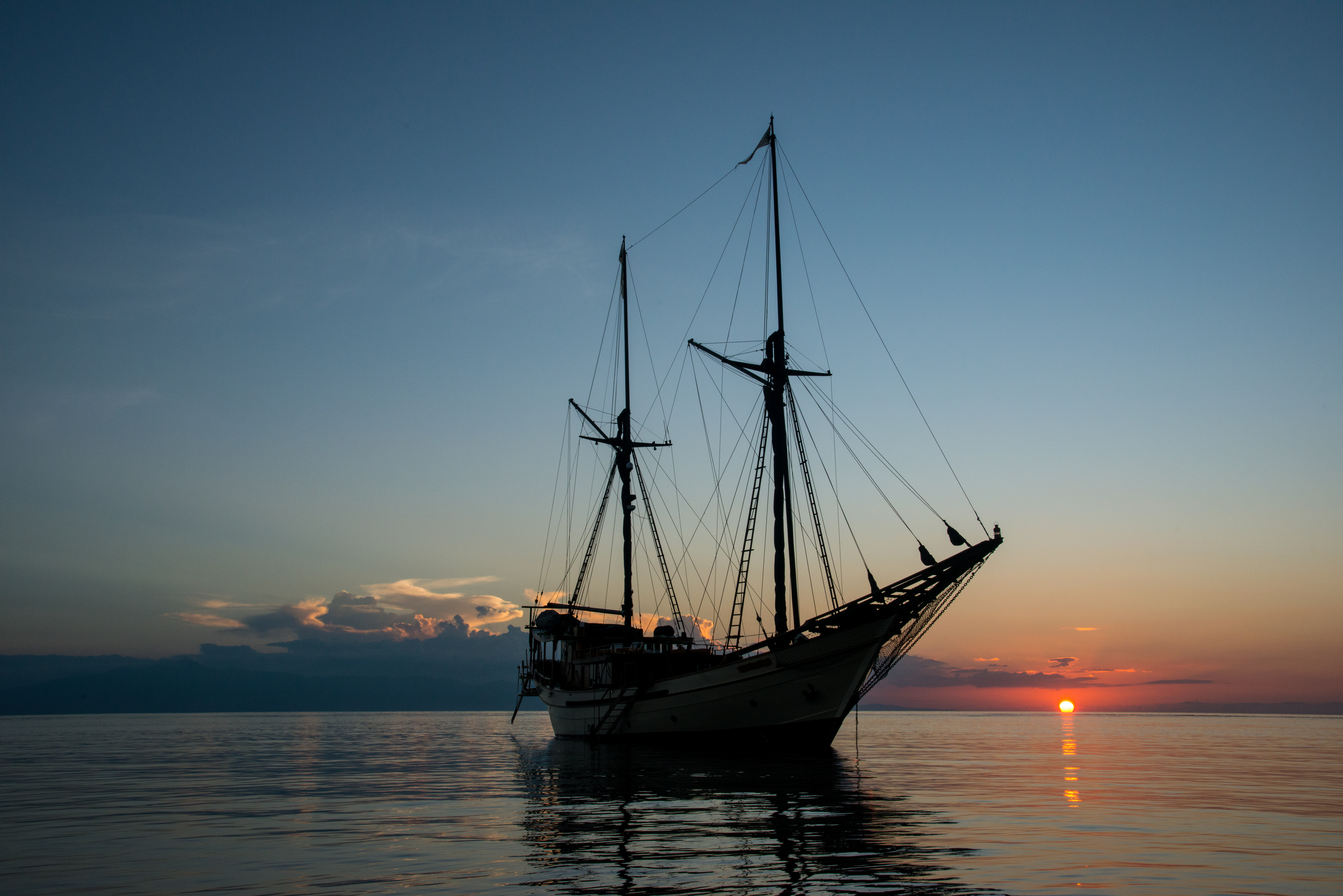
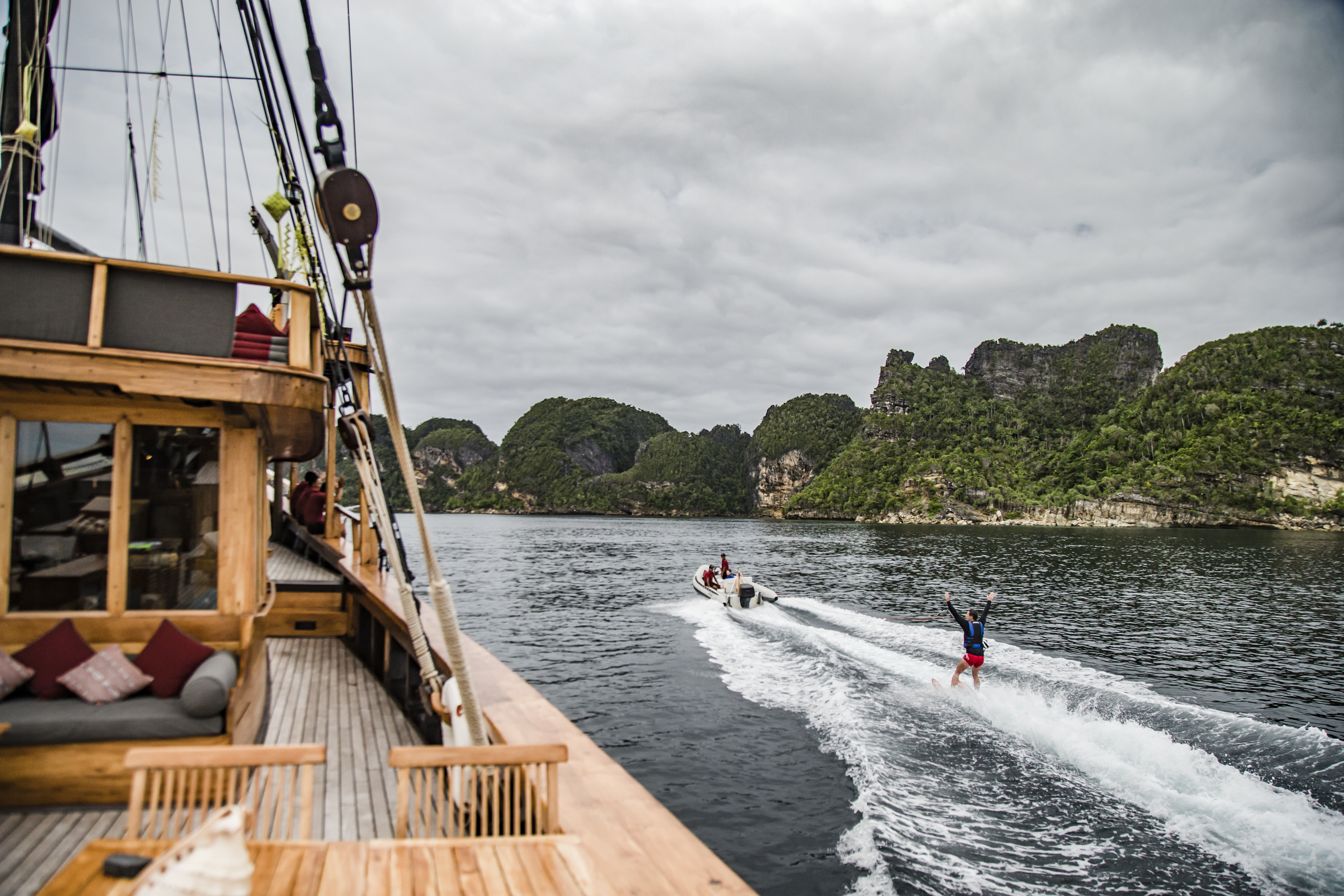
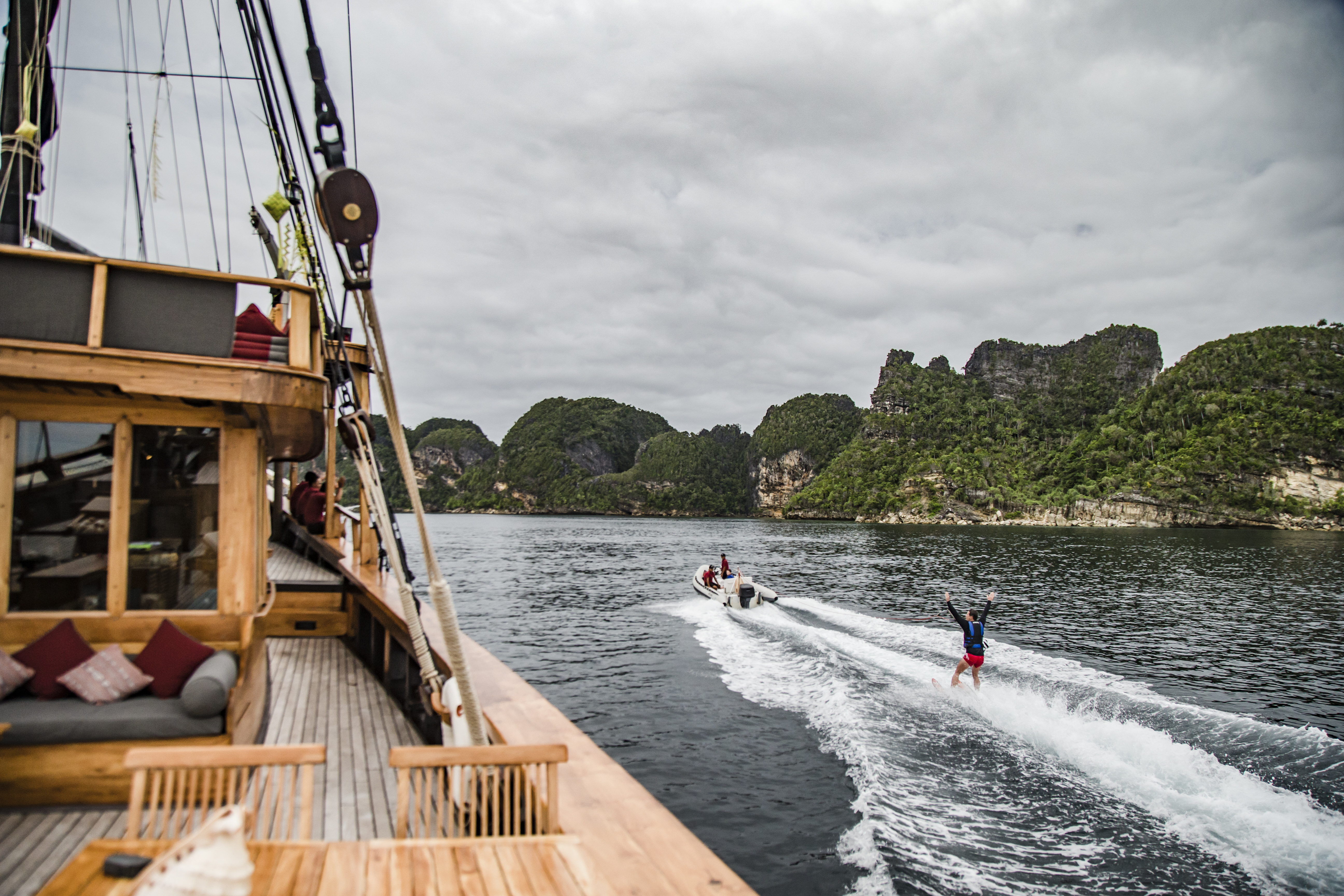
The Silolona and Si Datu Bua are traditional phinisi schooners, hand-crafted wooden sailing vessels built by Master Konjo boat builders of Sulawesi, combining the spirit of the original spice island sailing vessels with modern comfort and safety systems. Silolona, launched in 2004, is 50 meters in length with five suites and a crew of 17. Si Datu Bua offers a more intimate configuration for smaller groups who prefer their own private vessel. Neither is a steel expedition ship. Neither is designed for guests who prioritize connectivity or stability over character and immersion.
What both vessels offer, and what no steel yacht or boutique resort can replicate, is the experience of arriving at Banda Neira the way it was meant to be arrived at: by wooden ship, through the Zonnegat Passage, with the scent of nutmeg on the air before the islands come into view.
For guests who recognize that experience as the point, the voyage becomes one of the most significant they will ever take.
September and October: The Banda Sea in Season
Banda rewards travelers who understand timing. The Banda Sea is shaped by seasonal winds and oceanic exposure, and several specialist liveaboard and expedition sources identify September to November as one of the primary Banda Sea cruising windows, with September and October sitting at the center of the season.
For a private charter with Silolona or Si Datu Bua, these months offer three advantages. Sea conditions are generally more settled than the more exposed months. Marine life behavior aligns with the period when Banda's most compelling dive sites are most frequently visited. And the combination of heritage exploration and underwater discovery feels most balanced, with neither experience competing with the other, both available in the same days.
March, April, and October bring their own atmosphere to Banda. The sea becomes a corridor rather than a barrier. The islands feel present without feeling busy. The mornings invite walking; the afternoons invite the water; the evenings invite stillness and spice-scented air.
The Vessel That Makes the Voyage Possible
Banda is not a destination that rewards improvisation. Its distance from logistical support, its seasonality, its permit requirements, and its anchorages all demand a level of expedition planning that goes well beyond organizing a pleasant sailing trip.
Silolona Sojourns describes itself as an Indonesia expedition yacht specialist with 30 years of expertise, managing yacht protocols with port authorities, provisioning in remote areas, bunkering, customs clearance, and the deep local relationships that allow access to communities and places a first-time visitor would simply never find. In Banda specifically, those relationships include decades of association with local guides, access to privately held colonial properties, and the kind of tacit knowledge about seasonal conditions and anchorage timing that is not written down anywhere.
This is what allows the voyage to feel effortless on deck while being precisely managed below the surface of what the guest ever needs to think about. That combination of deep operational competence rendered invisible by seamless hospitality is the defining characteristic of a truly exceptional private charter.
The Original Spice Islands Still Sail in the Imagination
TheBanda Neira Archipelago is one of Indonesia's most quietly extraordinary destinations. Remote, historically immense, visually cinematic, and deeply human, it carries the weight of a history that shaped the modern world, held in landscapes that have been largely untouched by the mass travel that has arrived elsewhere.
Its forts speak of empire and spice. Its nutmeg gardens speak of continuity and cultivation. Its reefs, built over volcanic slopes and 1988 lava flows and written about by Wallace in 1860, speak of the extraordinary living richness of the Banda Sea. Its silence protects the feeling that you have arrived somewhere that has not been flattened by spectacle.
For the traveler seeking aBanda Islands yacht charter or a privateSpice Islands luxury cruise, Banda is not the obvious choice. That is precisely what makes it the right one.
WithSilolona Sojourns, the voyage becomes a private, curated expedition through the original Spice Islands, shaped by 30 years of regional expertise, aboard vessels built in the tradition of the ships that sailed these waters centuries ago, with the kind of local access that turns a beautiful journey into a genuinely meaningful one.
Plan Your Banda Sea Expedition
References
Britannica. In 1667, under the Treaty of Breda, the Dutch retained the Banda Islands while England accepted New Amsterdam, the future Manhattan. Available from Britannica.
van Donkersgoed J. Shifting the historical narrative of the Banda Islands: From colonial violence to local resilience. Wacana, Journal of the Humanities of Indonesia. 2023;24(3):500-514. doi:10.17510/wacana.v24i3.1657
Andradi-Brown DA, et al. Marine conservation in the Sunda Banda Seascape, Indonesia. Marine Policy. 2022. Available from ScienceDirect.
Kawaroe M, Nugraha AH, Juraij, Tasabaramo IA. Seagrass biodiversity at three marine ecoregions of Indonesia: Sunda Shelf, Sulawesi Sea, and Banda Sea. Biodiversitas. 2016;17(2). doi:10.13057/biodiv/d170228