

Why Ultra-Luxury Travellers Choose a Private Phinisi and When They Shouldn't
Nasir has built both of these vessels. In the early 2000s he was head carpenter on the hull that became Silolona, shaping tropical hardwood by hand in Ara, on the southern tip of Sulawesi, where his family has cut and joined timber for generations. He did it again for Si Datu Bua. And in a sense he is still building them, because a wooden vessel is never finished: it is maintained, re-caulked, re-oiled, watched, season after season. When people ask why a private phinisi charter draws travellers who could buy almost any experience on the water, the honest answer starts with him, and with the fact that the man who built the boat is often still aboard it.
Most of what is sold as private yacht chartering in Indonesia is a hotel that happens to float. It is comfortable, it is capable, and for a great many travellers it is exactly right. A phinisi is a different proposition, and being clear about that difference is more useful to you than another page of adjectives. So this article does two things. It makes the full case for the heritage phinisi, and then it tells you, by category and by name, when you should book something else instead.


Two categories matter here, not two products. There is the heritage expedition yacht, a hand-built wooden vessel crewed by people with long personal ties to the boat and the region. And there is the expedition hotel at sea, a modern steel or composite hull engineered for stability, dive volume, and the reassuring sameness of a fine hotel. Silolona and Si Datu Bua sit firmly in the first category. We are not going to pretend they belong in the second, because you will find out on day two if we do.
The case for the phinisi is a case about who is aboard, not what the hull is made of
Steel yachts hire crews. Heritage phinisi tend to keep them. On Silolona, Captain Bambang is known among returning guests as much for his sambal as his seamanship. Captain Kamto carries an unusually deep map of Indonesian waters in his head, the kind that comes from decades rather than a chartplotter. Goris Atawuwur, from Flores, was part of the team that built the boat, spent more than twenty years aboard as a dive instructor, and now leads the trips himself. Ketut Kusumawardana, from Buleleng in north Bali, runs the galley and has a particular hand with pastry and dessert. This is not a roster assembled for the season. It is closer to a household that happens to go to sea.
For the traveller who values experiences over possessions, this is the whole point. You are not buying square metres of teak. You are buying access to a group of people who know where the current turns near Banta, which village on Alor still weaves with natural dye, and what the weather is about to do before the sky shows it. That knowledge does not appear in a spec sheet, and it is precisely what a hotel at sea, however polished, struggles to replicate when its crew rotates every few months.
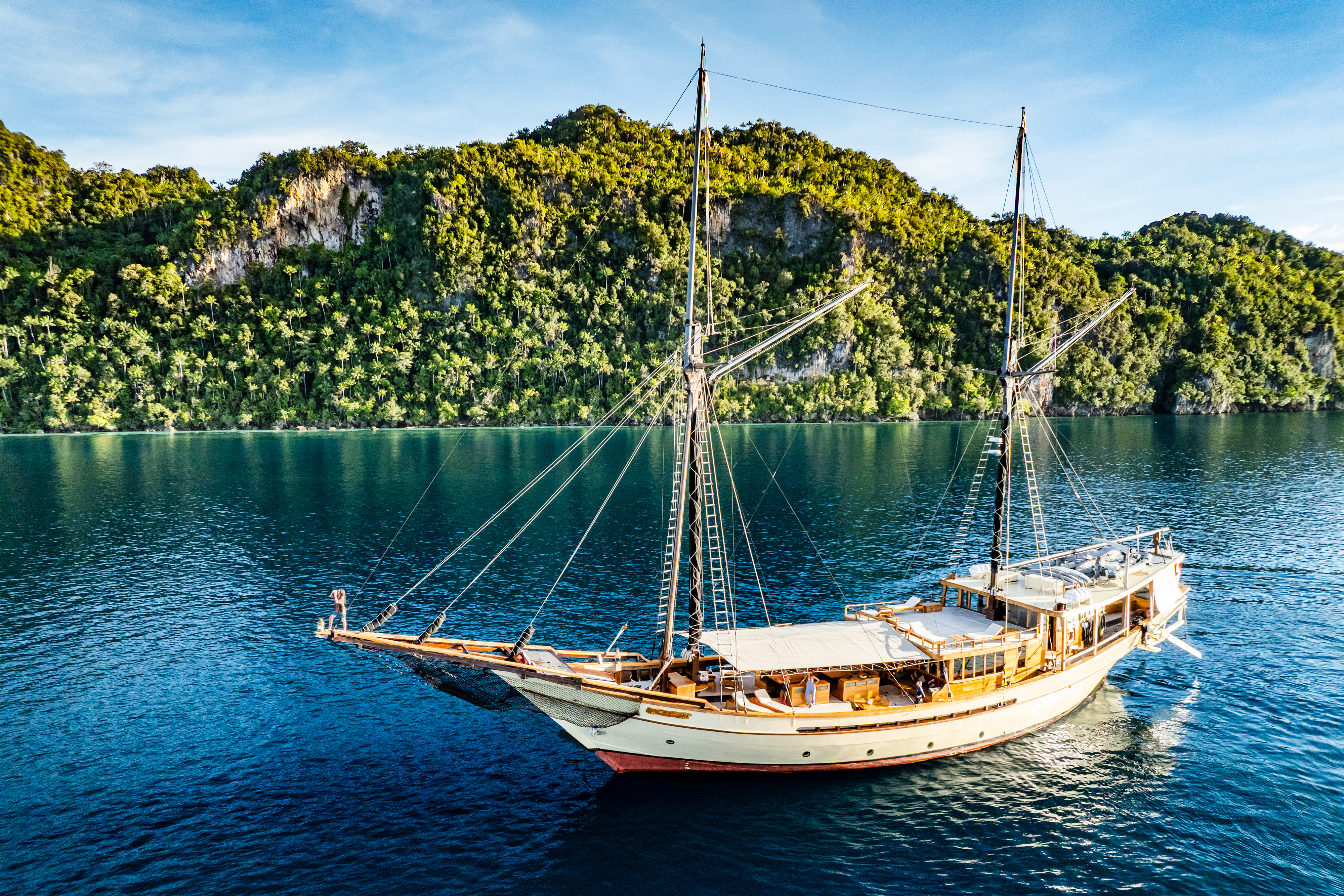
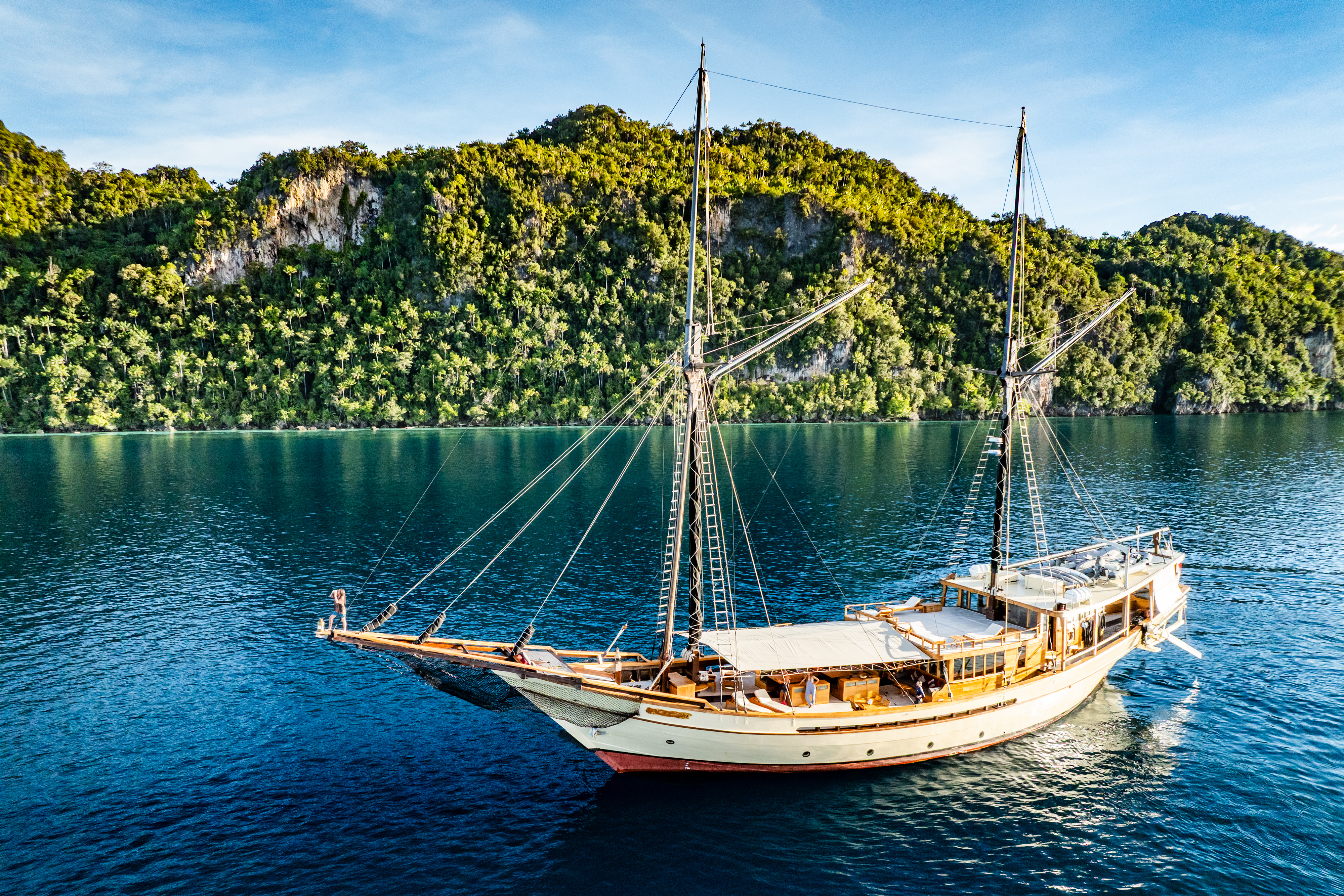
There is a craftsmanship argument too, and it is worth stating without mysticism. Silolona is 50 metres, built in 2004 by Master Konjo boat builders to German Lloyds specifications, using a tradition that UNESCO recognises as intangible cultural heritage. Si Datu Bua, at just over 40 metres, is smaller and more private, designed by Seery Yacht Design and built by the same community of shipwrights. Together the two vessels offer eight cabins, which is why families and groups who want to sail in company sometimes take them in tandem. The wood is not nostalgia. It is a living object made by named people, and it moves through water differently because of it.


Sailing a phinisi means accepting trade-offs a steel yacht is designed to erase
Here is where honesty earns its keep. A wooden sailing hull moves. In open crossings, a phinisi rolls more than a stabilised steel yacht with modern gyros, and if you are prone to seasickness on a swell, you will feel it. A phinisi is also not a dive factory. The rhythm of the day is built around exploration, culture, and pacing, not around squeezing four or five tank dives into daylight. If your measure of a good trip is dives logged per day, a dedicated dive platform will beat us on volume, and we would rather tell you now than watch you count.
What a phinisi gives back in exchange is access. A shallower working draft and nimble tenders let these boats tuck into bays, lagoons, and village anchorages that a deeper steel hull approaches only at a distance. In Raja Ampat, with its 600-plus islands and reefs holding roughly 1,200 fish species and 540 species of coral, the difference between anchoring in the postcard and anchoring near it is not small. The phinisi trades a degree of stability and dive count for intimacy and reach. That is the deal. It is a good deal for the right traveller and a poor one for the wrong one.
The comparison, stated straight
Set the two side by side by category rather than by verdict.
Heritage Expedition Yacht (phinisi) | Expedition Hotel at Sea (steel/composite) | |
|---|---|---|
Motion underway | More roll on open crossings; you feel the sea | Stabilised; motion largely engineered out |
Working draft | Shallower; reaches inshore bays and lagoons | Deeper; some shallow anchorages off-limits |
Stability at anchor | Good in sheltered water, livelier in swell | Very stable across conditions |
Dives per day | Typically two, paced around exploration | Dive-optimised programmes generally offer more |
Connectivity | Starlink onboard | Comparable or higher, often continuous |
Crew continuity | Long-tenured, many aboard for years | Varies by operator |
Itinerary changes | Reshaped underway, often the night before | Set in advance, adjusted where conditions require |
Which one suits you
A heritage phinisi is likely the better fit if shallow inshore bays and village anchorages are central to what you want to see, if you value cultural access and crew relationships as much as the marine life, if two considered dives a day with time ashore between them sounds better than four, and if you want the route reshaped around conditions rather than fixed in advance.
A steel or composite expedition vessel is likely the better fit if anyone aboard is prone to seasickness, if maximising dive count is the priority of the trip, if you need uninterrupted connectivity for work, or if predictability matters more to you than flexibility. In those cases, book the steel vessel. You will have a better week.
Book elsewhere if the following describes you
You should choose a steel or composite expedition hotel at sea, and not a phinisi, if any of these are true.
If someone in your party has genuine, medically relevant motion sensitivity that a patch and ginger will not settle, a gyro-stabilised steel yacht is the kinder choice. Comfort on a crossing is not a small thing when it decides whether a guest leaves the cabin.
If the trip's purpose is dive volume, technical diving, or a rigorous certification schedule, book a dedicated dive vessel. Boats such as those in the well-run steel liveaboard fleets working Raja Ampat and Komodo, which build their entire day around back-to-back tank dives, will out-dive a phinisi and should. Ask any charter broker for the current dive-focused liveaboards; they are easy to name and they do that job well.
If you want the seamless sameness of a five-star hotel, with every variable engineered flat, choose a modern expedition yacht from a European or Australasian builder. That predictability is a real product, honestly delivered, and some travellers rightly prize it.
If your priority is maximum onboard toys, tender fleets, and a spa footprint, a larger steel motor yacht simply carries more of that. A phinisi is intimate by design, and intimacy has a size.
None of that is a concession. It is the same advisory logic that makes the case for the phinisi credible in the first place. A recommendation that fits everyone fits no one.
Why the phinisi still wins for the traveller it suits
Strip away the marketing and the choice is about what you want the sea to feel like. The heritage phinisi is for the traveller who reads a wooden boat built by a named community as a feature, not a compromise; who would rather anchor inside the quiet bay than off it; who values a crew that has been aboard for years over one assembled for the season; and who accepts a livelier crossing as the price of reaching places a deeper hull cannot. Research on the Coral Triangle keeps making the same point about these waters, that biodiversity and the human communities around it are deeply linked, and that the best outcomes come from travel that engages both rather than skimming past.1 A phinisi, moving slowly and drawing little, is built to engage both. Studies of heritage and cultural tourism find that travellers increasingly seek meaning and authenticity of place rather than standardised comfort,2 which is close to a description of who books these boats. And work on dragon tourism in this region has long shown that responsible, locally rooted travel returns more to the places visited than high-volume alternatives,3 a quieter argument for the slow, small, culturally connected way of moving that a phinisi makes possible.
With Silolona Sojourns, the terms are stated plainly on both sides, which is the only way a journey of this kind should be discussed. If what you want is the hidden coves of the Komodo archipelago, the reef walls of Raja Ampat, or the nutmeg-scented history of Banda at a pace set by the sea rather than a schedule,Silolona and Si Datu Bua were built for exactly that, by people who still sail them. Charters are all-inclusive: meals, crew, expedition leader, dive and watersports gear, transfers, permits, and connectivity are covered, so nothing meaningful is billed separately once you are aboard. If that is the journey you want, enquire, and we will tell you honestly whether it fits, and where it would not.
References
Cinner JE, Huchery C, MacNeil MA, et al. Bright spots among the world's coral reefs. Nature. 2016;535(7612):416-419. doi:10.1038/nature18607.
Silberberg T. Cultural tourism and business opportunities for museums and heritage sites. Tour Manag. 1995;16(5):361-365. doi:10.1016/0261-5177(95)00039-Q.
Walpole MJ, Goodwin HJ. Local economic impacts of dragon tourism in Indonesia. Ann Tour Res. 2000;27(3):559-576. doi:10.1016/S0160-7383(99)00088-2.